Dry Leaf: Appearance & Aroma
The dry leaf is the first and most immediate indicator that this is not a fresh-production Dianhong. As the product images show clearly, the individual strips are compact, tight, and deeply colored — a warm antique bronze to dark reddish-brown, without the bright golden-amber surface of a fresh bud-grade Dianhong from the same origin. The trichome coating that would be visible and prominent on a fresh golden-bud Dianhong has been largely absorbed and transformed over three years of maturation — the surface now presents as a settled, high-sheen brown rather than a bright, fluffy gold. The overall visual impression is one of composure: the leaf looks settled and finished rather than vivid and active.
The dry aroma has undergone the most dramatic transformation from the fresh-production equivalent. The characteristic bright honey-sweet and floral top notes of a fresh Fengqing bud Dianhong have resolved entirely. What remains is a deeper, rounder, and more complex aromatic profile: the primary note is warm dark honey and aged wood — not sharp or chemical wood, but the clean, dry scent of well-seasoned timber or the interior of a cedar chest. A secondary note of dried plum and dark raisin sits beneath the wood-honey base, and there is a tertiary note of clean dried flowers — not the bright fresh florals of a new tea, but something softer and more aged, closer to pressed dried osmanthus or rose petals from last season. The 火气 (Huǒ Qì, fire energy) that would be detectable in any fresh black tea's dry aroma — a slight sharpness or volatility — is completely absent. The aroma of this tea is settled, round, and unconditionally warm.
Wet Leaf: Post-Brew Appearance & Aroma
After brewing, the leaves rehydrate into a deep, uniform chocolate-brown — entirely consistent in color, with no residual golden or amber patches remaining. As visible in the product images, the wet leaf bowl shows a mass of fully and evenly matured leaf material with a rich, dark brown surface and visible elasticity. The uniformity of the wet leaf color is one of the clearest visual indicators of a complete and even three-year maturation: any uneven or patchy coloration in the wet leaf would suggest inconsistent storage conditions or partial maturation. This batch shows none of that.
The wet leaf aroma after the first steeping is one of the most immediately compelling aspects of this tea. The deep, warm honey-wood notes of the dry leaf are amplified by heat and moisture into something that wine drinkers would describe as the bouquet of a bottle opened after appropriate aging: round, layered, and harmonious, with no individual note competing aggressively for attention. Dark honey, dried fruit, clean aged wood, and a subtle note of warm spice (close to dried cinnamon bark rather than sharp fresh spice) combine into a unified, settled aromatic experience. There is no mustiness, no earthiness, no hint of warehouse or humidity influence — the Xi'an dry-storage environment's most important contribution is the complete absence of any off-note in the wet leaf, which is the clearest marker that the maturation was clean.
Liquor Color
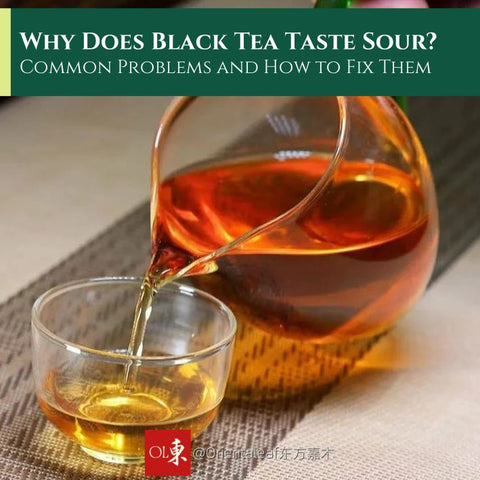
The liquor color is one of the most visually distinctive aspects of the 2023 Vintage Dianhong and is immediately apparent in the product images. A deep, clear amber-red — not the vivid, forward red of a fresh Dianhong, but something deeper, more settled, and more internally warm — fills the glass pitcher and the drinking cup with a quality that experienced aged-tea drinkers will recognize immediately as the color of time.
- First and second steepings: Deep clear amber-red with excellent transparency and a warm, backlit quality. The color sits between a mature Bordeaux red and a well-aged aged Armagnac — deep, warm, and glowing rather than bright or vivid. As visible in the product images, the liquor in a small white cup shows a deep, even red-amber with no cloudiness, no sediment, and no flat opacity.
- Third through sixth steepings: Maintains the deep amber-red character with consistent clarity. The color evolves very slowly across steepings — this is another marker of fully matured material, which releases compounds more evenly across a long steeping session than fresh material does.
- Later steepings: Deepens slightly toward a richer, more red-brown tone before fading gracefully to a warm copper-amber in the final steepings. The liquor remains clear throughout — never cloudy.
Mouthfeel
- Texture: The defining quality of this tea and the most immediately impactful evidence of the three-year maturation. The texture is round, full, and uniformly smooth — there is no moment of structural tannin contact, no dry finish, and no perceivable edge anywhere in the cup. Chinese tasters use the compound term 醇厚圆润 (Chún Hòu Yuán Rùn, mellow-thick-round-smooth) for this quality, which requires extended maturation to fully achieve and cannot be produced by any processing technique applied to fresh material.
- Entry: Smooth and immediate — the liquor contacts the palate without any assertiveness or sharpness. The entry is not light or delicate in the way of the Imperial Dianhong; it is full and present, with clear body weight, but it arrives without any friction.
- Body weight: Full and substantial. The three-year maturation has not thinned the tea's body — it has reorganized the molecular structure of the polyphenols from sharp, high-molecular-weight tannins into rounder, softer compounds that contribute body weight and texture that contribute body weight and texture without any of the gripping or drying sensation associated with those same polyphenols in their fresh, unaged state. The closest single analogy is the difference between a young, tannic red wine and the same wine after eight to ten years of correct bottle aging: the structure is still present, still providing backbone, but it has integrated completely into the overall experience rather than announcing itself as a separate, potentially uncomfortable element.
- Tannins: Fully integrated and undetectable as a separate sensation. The tannin structures of the original 2023 Dianhong have undergone three years of slow polymerization and molecular decomposition — the same class of chemical change that softens tannins in aged wine and aged pu-erh, but here occurring in a black tea context through the specific low-humidity, stable-temperature conditions of Xi'an dry storage. The result is a cup with clear structural presence but zero tannin perception.
- Huigan (回甘, Huí Gān — returning sweetness): Deep, warm, and sustained. The return sweetness of a three-year dry-stored Dianhong is qualitatively different from that of a fresh tea — it arrives not as a sharp, clean spike but as a gradual, warm spreading of sweetness in the throat that develops over 10 to 20 seconds and holds for 3 to 5 minutes per sip. The character of the sweetness is dark and warm — closer to aged dark honey or dark molasses than to the bright floral honey of a fresh golden-bud Dianhong.
- Shengjin (生津, Shēng Jīn — salivation): Moderate and sustained. The salivation response is even and comfortable, contributing to the overall sensation of roundness and satisfaction without the active intensity of a high-glycoside wild tea.
Core Flavor Notes
Primary: Dark honey, aged wood, dried plum, warm malt
Secondary: Dark raisin, dried osmanthus, clean caramel, faint cinnamon bark
Tertiary (on cooling and later steepings): Subtle dark chocolate, clean leather, aged dried fruit compote, warm mineral undertone
For wine comparison: the profile is closest to a well-aged Rhone Valley red — Chateauneuf-du-Pape or Gigondas after 8 to 10 years of correct cellar storage — where the primary fruit has given way to secondary and tertiary complexity, the tannins have integrated completely, and what remains is a round, warm, harmonious cup with a finish that outlasts the glass. The specific combination of dark honey, aged wood, and dried fruit in a smooth, full-bodied context is the most direct parallel.
For aged spirits comparison: the profile is also usefully compared to a well-aged Armagnac or a 12-year Scotch malt stored in sherry casks — the same combination of honey, dried fruit, warm wood, and faint spice in a rounded, non-harsh context.
For specialty coffee comparison: the closest reference is a naturally processed coffee from a well-established single estate, rested for 6 to 12 months post-roast — the sharpness of fresh roast has resolved, the fruit notes have deepened and dried, and what remains is a round, complex, satisfying cup that rewards slow attention.
Empty Cup & Finish
The 杯底香 (Bēi Dǐ Xiāng, base-of-cup aroma) of a three-year dry-stored Dianhong is among the most persistent and complex of any tea in the Orientaleaf range. The empty cup retains a warm, dark-honey and aged-wood fragrance for 8 to 12 minutes after the last sip — a duration and depth that reflects the concentration and stability of the matured aromatic compounds. This fragrance does not dissipate quickly as the cup cools; it lingers, shifts slightly from warm-sweet to dry-woody as the residual temperature drops, and remains present and identifiable long after the cup would normally be considered empty.
The in-mouth finish is the longest and most sustained in the Orientaleaf Dianhong range. The warm sweetness established on entry deepens in the throat over the 60 seconds following each sip, and the combination of huigan warmth and throat resonance (喉韵, Hóu Yùn) holds comfortably for 4 to 6 minutes per steeping in a well-conducted gongfu session. The finish is clean — no tannin residue, no flat aftertaste, no stale quality of any kind — and it accumulates across steepings into a sustained, deeply warm sensation that makes the 2023 Vintage Dianhong genuinely suited to slow, evening drinking without any burden.
Body Sensation / Cha Qi
The Cha Qi (茶气, Chá Qì) of a three-year dry-stored Dianhong is one of the most interesting aspects of this category and one that most drinkers do not anticipate from a black tea. The maturation process has not reduced the tea's Cha Qi — it has transformed its character from the forward, upward warmth of a fresh black tea into something deeper, slower, and more settling. The sensation builds gradually over a full gongfu session rather than arriving quickly, and it centers in the chest and lower abdomen rather than in the head and upper chest as a fresh, vivid Dianhong might. Experienced aged-tea drinkers will recognize this as the shift from yang-forward to a more balanced, grounding quality — a characteristic that aged teas across categories share regardless of whether the aging occurred in a Yunnan pu-erh warehouse, a Bordeaux cellar, or a Xi'an dry-storage facility.
The high L-theanine content of the original bud-grade material remains intact through the maturation process — L-theanine is a stable compound that does not significantly degrade under correct dry-storage conditions — which means the calm, anxiety-free alertness characteristic of premium bud-grade Dianhong is preserved in the 2023 Vintage. The combination of mature, settling Cha Qi and sustained L-theanine calm makes this the most appropriate black tea in the Orientaleaf range for evening and late-day drinking.
- Cha Qi Intensity: 2.5 / 5 — moderate, warm, and grounding; distinctly different in character from the forward intensity of a fresh or wild-tree Dianhong
- Warmth Profile: Deep and settling — centered in the chest and lower abdomen, accumulating slowly across a full session
- Stimulation Profile: Calm and sustained — the L-theanine preservation through dry storage means the caffeine effect remains moderated; this is the most appropriate evening black tea in the Orientaleaf range for most drinkers
- Best drunk: Afternoon through evening; ideal for slow, meditative sessions; genuinely calming without being soporific; the natural companion to a quiet evening rather than an active morning