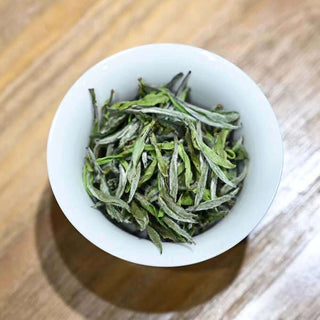
Dry Cake Appearance & Aroma
The 300g cake presents moderate compression—tight enough to preserve structure but loose enough to allow airflow for aging. The surface displays a beautiful mosaic of silvery-white down (white pekoe) interspersed with olive-green and earth-brown mature leaves, characteristic of Shou Mei grade. Break off a corner and you immediately encounter the dry aroma: sweet hay, dried apricot, and a whisper of wild honey. There's a clean, almost chalky minerality underneath—the signature of high-altitude Lincang terroir.
Wet Leaf After Brewing
Once steeped, the leaves unfurl to reveal intact, plump leaf sets ranging from one bud with two-to-three leaves. Colors shift to jade green edges with bronze-amber centers, indicating gentle oxidation during the four years of dry storage. The wet leaf aroma intensifies into warm pastry notes, toasted rice, and crushed white flowers—think chamomile meets warm brioche. Rubbing the spent leaves between your fingers releases a subtle apricot kernel sweetness, a hallmark of properly aged white tea.
Liquor Color
The tea brews to a luminous pale amber with golden highlights, crystal-clear with no cloudiness. As infusions progress, the color deepens slightly to light honey-amber, maintaining transparency throughout. This clarity signals clean dry storage—no murky sediment, no off-color tints from improper humidity.
Mouthfeel & Texture
The first sip reveals surprising body for a white tea—this is where Yunnan's large-leaf genetics shine. The texture is smooth and slightly oily, coating the palate with a velvety, almost creamy viscosity absent in thinner Fujian styles. There's gentle astringency in the front palate that quickly dissolves into persistent sweetness across the mid-tongue. The tea produces immediate salivation (生津, Shēng Jīn) and builds to a clean, cooling sweetness (回甘, Huí Gān) that lingers for 10-15 minutes after swallowing. Mouthfeel evolves across infusions: early steeps offer crisp refreshment, middle steeps develop silky roundness, and later infusions settle into soft, meditative clarity.
Core Flavor Notes
- Primary Notes: Raw honey, white peach, rice pudding
- Secondary Notes: Dried apricot, sweet hay, steamed rice cake
- Tertiary Notes (from aging): Light caramel, jujube sweetness, subtle sandalwood
- Umami Undercurrent: Savory minerality, reminiscent of clean spring water over river stones
- No Bitterness: The large-leaf Shou Mei grade, combined with dry storage, eliminates harsh tannins entirely
Comparison Note: If you enjoy the delicate florals of Darjeeling First Flush or the honeyed complexity of aged white wine (Sauternes), this tea will resonate. Unlike aggressive aged Pu-erh, it maintains white tea's signature gentle elegance while adding layered depth from time.
Empty Cup Fragrance & Finish
After pouring out the liquor, the empty cup (杯底香, Bēi Dǐ Xiāng) releases an intoxicating warm rice pudding aroma tinged with dried wildflowers. The finish is medium-long and evolving—it starts with clean sweetness, transitions to subtle nutty dryness, and resolves into a cooling menthol sensation at the back of the throat. The aftertaste doesn't shout; it whispers, inviting you back for the next infusion.
Body Sensation & Tea Energy (Chaqi)
- Warmth: Gentle warming sensation begins in the chest and radiates outward—comforting without overheating
- Clarity: Mental alertness without jitters; promotes focused calm rather than sedation
- Relaxation: Subtle muscle relaxation in shoulders and jaw; many drinkers report a "softening" effect on tension
- Digestive Comfort: Traditional use for soothing the stomach is noticeable; a sense of lightness in the belly
- Breath: Some detect a slight opening of the respiratory passages—white tea's historical reputation for "cooling heat and moistening lungs" (清热润肺, Qīng Rè Rùn Fèi)
- Tea Energy Intensity: 3.5/5 - Moderate to moderately-strong. Present and noticeable but not overwhelming; suitable for afternoon or early evening without disrupting sleep.