Dry Leaf: Appearance & Aroma
The dry leaf is the most immediately impressive visual presentation in the Orientaleaf Dianhong range, and as the product images clearly show, it is immediately distinguishable from every other grade. Each individual piece is a straight, upright golden needle — clean, uniform, and untwisted — with a surface covered in a dense, intact pale-gold trichome coating that gives the entire batch a luminous, almost metallic warmth when viewed in direct light. The needles are fat and full at the base, tapering to a fine point at the tip — a visual indicator of the bud's stage of development at harvest, which was at or just before first emergence. There are no curved, coiled, or twisted pieces in a correctly produced batch of this grade; any such pieces indicate a mix-in of lower-grade material.
The difference between this tea's dry leaf and the Golden Buds Classic Dianhong — which is also a single-bud grade — is immediately visible on close inspection. The Classic has a warm golden-amber surface with the characteristic slightly compressed needle form of a rolled bud. The Imperial has a cooler, cleaner pale-gold surface with a notably more intact and uniform trichome coating, and the needle form is visibly straighter and more upright — the direct result of 理条 (Lǐ Tiáo) rather than 揉捻 (Róu Niǎn).
The dry aroma is delicate, clean, and floral — lighter and more refined than any other tea in the Dianhong range. The primary note is fresh honey and light floral — closer to acacia blossom or light osmanthus than to the baked-sweet-potato warmth of the Golden Snail or the dark honey depth of the Ancient Tree. There is a secondary note of fresh hay and clean spring air, and a very faint sweetness that sits at the edge of perception. The aroma rewards proximity: hold the needles close and breathe slowly, and the floral character opens distinctly. At arm's length, this tea is quieter than any other in the range — which is entirely consistent with its character.
Wet Leaf: Post-Brew Appearance & Aroma
After brewing, the straight needles rehydrate into clean, upright, fully intact single buds — each one a complete, undamaged first emergence bud with uniform color ranging from pale golden-brown at the trichome-coated surface to a warm amber in the bud body. The bud retains its closed, neat form even after multiple steepings — it does not fully open into a flat leaf in the way that a bud-plus-leaf grade material does, because the leaf primordia within the bud are still tightly compressed at the point of harvest. This means the wet leaf display in a glass gaiwan or clear cup is a collection of intact, rehydrated golden needles floating in pale golden liquor — visually one of the most refined and elegant presentations in Chinese black tea.
The wet leaf aroma is the most floral and least caramel-forward of any tea in the Orientaleaf Dianhong range. The primary note is clean honey-floral — fresh rather than baked, light rather than dark — with a secondary note of warm vanilla and a whisper of white peach or light apricot. The trichome dissolution that begins immediately on contact with hot water contributes a faint, clean savory-sweet quality to the wet aroma that is difficult to name precisely but is immediately recognizable to anyone who has brewed a top-grade Bai Hao Yinzhen: it is the smell of fine proteins and amino acids in hot water, clean and slightly creamy.
Liquor Color
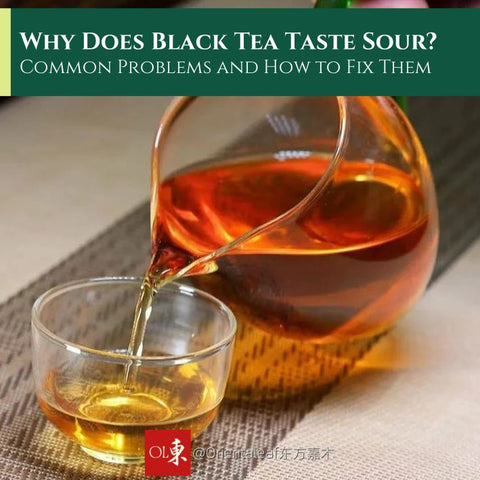
The pale gold liquor color of the Imperial Dianhong is the most immediate visual differentiator from every other tea in the Orientaleaf range and from virtually every other black tea most drinkers will have encountered. As visible in the product images, the first and second steepings produce a clear, bright, warm gold — closer in color to a high-grade Longjing green tea or a top-tier Darjeeling first flush than to any standard red-liquor Dianhong. The color is not a sign of under-extraction; it is a direct consequence of the near-absence of thearubigin compounds in a pure-bud material with minimal polyphenol content.
- First and second steepings: Clear, bright pale gold — warm and luminous, with no red or amber tones. In direct light, the trichome particles in suspension give the liquor a faint, soft haziness that is visually similar to a dry-farmed natural wine poured without filtration.
- Third through fifth steepings: Deepens marginally toward a warm, clear amber-gold as the bud interior continues to release compounds across steepings. Remains significantly lighter than any other Dianhong grade throughout.
- Later steepings: Pale, clean golden-yellow — still sweet, still smooth, still fully enjoyable at steeping 8 or beyond.
Mouthfeel
- Texture: Ultra-silky and enveloping — the defining physical quality of this tea and the one that generates the strongest immediate reaction from first-time drinkers. The sensation is not the round, full-bodied weight of a bud-and-leaf Dianhong; it is a fine, coating, wrapping quality that covers every surface of the mouth simultaneously. Chinese tasters describe this as 包裹感 (Bāo Guǒ Gǎn, enveloping sensation) — the feeling that the liquor is surrounding rather than simply passing through the mouth. This quality is produced by the trichome dissolution described above, and it is unique to teas with very high intact trichome density — which is to say, it is essentially unique to needle-straightened single-bud teas of this grade. No rolling process, no leaf-grade material, and no processing technique can replicate it — because the trichome coating that produces it is partially destroyed by rolling and is absent from any leaf-grade material regardless of how it is processed.
- Sweetness: Exceptionally high, clean, and immediate. The sweetness registers on entry without any delay or build-up — it is present in the first contact with the lips and the tip of the tongue, and it is the dominant sensory quality of the entire cup. The character of the sweetness is lighter and more floral than the dark honey or caramel sweetness of other Dianhong grades — closer to light acacia honey or fresh lychee than to baked caramel or dried fruit.
- Tannins: Effectively absent. The pure bud material of this tea has the lowest polyphenol and tannin content of any grade in the Orientaleaf Dianhong range by a significant margin. In practical terms: there is no moment of grip, no dry finish, no trailing astringency, and no perceivable structural tannin presence at any point in the steeping sequence. The liquor moves through the mouth and throat without any friction — which is the most direct way to explain the steeping tolerance advantage of this tea.
- Steeping Tolerance (冲泡容错率, Chōng Pào Róng Cuò Lǜ): This is the practical advantage that matters most to everyday brewing. Because there are effectively no tannins to over-extract, this tea cannot become bitter or astringent regardless of how long you steep it within any normal brewing parameter. A steeping of 30 seconds, 3 minutes, or even longer at 95 degrees Celsius will produce a cup that is sweeter or lighter in different ways, but never bitter or harsh. This is a genuinely unusual quality in any fully oxidized black tea and is one of the most frequently cited reasons customers return to this grade after trying it for the first time.
- Huigan (回甘, Huí Gān — returning sweetness): Light, clean, and floral. The return sweetness arrives gently within 5 to 8 seconds of swallowing and persists as a quiet, clean floral note in the throat — more subtle than the strong, bilateral return sweetness of the Wild Wilderness Dianhong, but consistently present and consistently pleasant across every steeping.
- Shengjin (生津, Shēng Jīn — salivation): Gentle and even. The liquor produces a mild, comfortable moistening of the palate that contributes to the overall enveloping sensation without the active, flooding salivation of a high-tannin or high-glycoside tea.
Core Flavor Notes
Primary: Light honey, acacia blossom, fresh osmanthus, clean floral sweetness
Secondary: White peach, light lychee, fresh vanilla, warm hay
Tertiary (on cooling and later steepings): Subtle cream, light dried apricot, clean mineral sweetness, faint rice
For wine comparison: the profile is closest to a well-made dry Alsatian Muscat or a light Vouvray demi-sec — aromatic, floral-forward, clean sweetness with no heavy fruit or oak character, and a finish that is long, pure, and consistently pleasant without complexity barriers.
For specialty coffee comparison: the closest reference is a very lightly roasted, washed Kenyan or Ethiopian Yirgacheffe brewed at low temperature as a pour-over — floral, honey-sweet, clean, and bright, with a finish that reads as fresh rather than roasted or caramelized.
For white tea drinkers: the Imperial Dianhong occupies a position directly adjacent to a top-grade Bai Hao Yinzhen (白毫银针, White Hair Silver Needle) — same single-bud material philosophy, same trichome-derived mouthfeel, same clean floral sweetness. The difference is processing: the white tea undergoes minimal oxidation and drying only, producing a lighter, more delicate cup; the Imperial Dianhong undergoes medium oxidation, producing a slightly more developed sweetness and a marginally warmer aromatic profile while retaining all of the defining mouthfeel qualities.
Empty Cup & Finish
The 杯底香 (Bēi Dǐ Xiāng, base-of-cup aroma) of the Imperial Dianhong is the most delicate and refined empty-cup fragrance in the Orientaleaf range. The empty cup retains a clean, light honey-floral fragrance — fresh, not baked — for 5 to 8 minutes after the last sip. It is a quiet fragrance that rewards attention: it does not announce itself from across the room the way the Golden Snail's caramel-sweet empty cup does, but it is persistent and precise, and it stays true to the floral-honey character of the liquor throughout.
The in-mouth finish is the cleanest of any tea in the Orientaleaf Dianhong range: no tannin residue, no flat or stale aftertaste, no trailing bitterness of any kind. The finish is a quiet, sustained floral sweetness in the throat that holds for 2 to 4 minutes and leaves the palate completely clean and refreshed — prepared for the next cup rather than weighted by the last one.
Body Sensation / Cha Qi
The Cha Qi (茶气, Chá Qì) of the Imperial Dianhong is the gentlest in the Orientaleaf range, and this is entirely consistent with the nature of the material. A pure-bud, high-amino-acid, low-polyphenol tea processed to emphasize sweetness and silk rather than structural intensity will not produce a forceful or dramatic body sensation. What it does produce is a quiet, clean warmth in the chest and a sustained, calm alertness that is among the most comfortable caffeine-adjacent experiences available in the Chinese tea category. The high L-theanine (茶氨酸, Chá Ān Suān) content of pre-Qingming single-bud material — the highest of any harvest timing in the Chinese tea calendar — is directly responsible for this quality: L-theanine modulates the caffeine response from sharp stimulation into sustained, anxiety-free clarity.
For drinkers who are sensitive to caffeine's more anxious effects, or who have found that coffee and standard black tea produce unwanted jitteriness or heart-rate elevation, the Imperial Dianhong is the most reliably comfortable caffeinated tea in the Orientaleaf range. The combination of meaningful caffeine content, very high L-theanine, and minimal polyphenol load produces a sustained, calm, focused alertness that experienced tea drinkers describe as the cleanest energy of any morning tea.
- Cha Qi Intensity: 1.5 / 5 — the gentlest in the Orientaleaf Dianhong range
- Warmth Profile: Mild and clean — a quiet warmth centered in the chest and upper stomach, without the radiating heat of wild or ancient tree material
- Stimulation Profile: Clean and sustained — the highest L-theanine-to-caffeine ratio in the range produces the smoothest, most anxiety-free alertness of any tea in this series
- Best drunk: Morning through mid-afternoon; well-suited to meditative or focused work sessions; ideal for drinkers who want the clarity of a caffeinated morning tea without any of the edge