🍵 15% off · TREAT15   🎁 Gifts from $100
🍵 15% off teas · TREAT15   🎁 Free tea gifts at $100 / $150 / $200

A Little Reward for You

Explore the year-end tea offer →

Make time for a little tea, just for you. Enjoy 15% off eligible teas with code TREAT15, from now through November 30, 2026 (Anywhere on Earth, UTC−12).

More tea to enjoy

  • Spend US$100: a full box of Golden Flower White Tea — 10 individually packed 3g portions, 30g total.
  • Spend US$150: the white tea box, plus one 100g Yunnan Red Glow ripe Pu-erh cake.
  • Spend US$200: both gifts above, plus one 100g The Little Brick — 2018 Golden Flower Fu Brick Tea.

Your first order also comes with a complimentary tea towel. No minimum spend or code is required for this welcome gift, and it can be enjoyed alongside the tea gifts above.

A few simple details

  • Gift thresholds are based on the amount paid for eligible merchandise after discounts, excluding shipping, taxes and gift value. Discovery Boxes and teaware count toward gift thresholds but are excluded from the 15% discount. K KOU electric kettles are excluded from both the discount and gift thresholds.
  • Gift thresholds are in US dollars. Other currencies are converted using the exchange rate applied at checkout; eligibility is based on the corresponding USD merchandise amount.
  • Qualifying gifts are cumulative, with one set per order. The offer can be used on multiple orders; orders cannot be combined to reach a threshold.
  • Standard shipping is US$9.50 per order. Orders qualifying for the existing “No Shipping Fee for Discovery Box” offer receive free shipping, including other items purchased in the same order.
  • The 15% discount combines only with “No Shipping Fee for Discovery Box”; it cannot be combined with other discounts. The gifts described here are part of this promotion.
  • If a gift is unavailable, we may substitute another gift of equal or greater retail value without separate notice.
  • The same offer continues through Singles’ Day, Black Friday and Cyber Monday.

Valuta

Il tuo carrello

Il tuo carrello è vuoto

Tè bianco Snow Bud da alberi antichi 2018 | Torta Silver Needle di Fengqing

300-Year-Old Ancient Trees | Pure Single Buds | 8 Years Dry-Stored Transformation

Price:
Prezzo di listino $61.50
Prezzo unitario
per
(0 nel carrello)
Flat US$9.50 shipping per order — any order size.

Dispatch within 48 hours. Shipping policy

Spese di spedizione calcolate al check-out.
100% Secure payments
AliPay
American Express
Apple Pay
Bancontact
Google Pay
iDEAL Wero
Mastercard
MB WAY
PayPal
Shop Pay
Union Pay
USDC
Visa
WeChat Pay

Your transaction is protected with advanced security measures to keep your information confidential

Tea profile

  • Tea Type: White Tea — Silver Needle Grade (Bai Hao Yin Zhen Style)
  • Raw Material: 100% Single Buds (Ya Tou) from Yunnan Large-Leaf Varietal (Da Ye Zhong)
  • Tree Age: 300+ Years Old Ancient Trees (Gu Shu)
  • Harvest Year: 2018, Early Spring (Pre-Qingming, approximately April 4-6)
  • Harvest Season: First Flush Spring Picking
  • Production Region: Xiangzhuqing Village, Fengqing County, Lincang Prefecture, Yunnan Province, China
  • Terroir: High-altitude ancient tea forest with 3,200+ documented ancient trees
  • Processing: Traditional White Tea Method — Withering (Wei Diao) and Low-Temperature Drying; No Kill-Green, No Rolling
  • Form: Compressed Cake (Bing Cha)
  • Available Sizes: 357g Full Cake / 30g Sample Size
  • Storage History: 8 Years Dry Storage (Gan Cang) in Xi'an, Shaanxi
  • Storage Conditions: Naturally dry, ventilated warehouse environment; verified clean, odor-free, and mold-free
  • Current Maturity Stage: Mid-Aged White Tea — Past initial transformation, entering optimal drinking window with continued aging potential
  • Pressing Year: 2018

About this tea

A rare 2018 Silver Needle pressed from 300-year-old ancient tea trees in Yunnan's legendary Xiangzhuqing grove—years of meticulous dry storage have transformed these pristine single buds into liquid silk with haunting honey and forest notes.

  1. 300-Year-Old Ancient Tree Origin — Harvested exclusively from tea trees aged over three centuries in Xiangzhuqing's protected 3,200-tree ancient grove, delivering unmatched depth and mineral complexity unavailable from plantation teas.
  2. 100% Pure Single Buds — Every gram consists solely of pristine spring buds (Ya Tou), the most labor-intensive and precious grade of white tea, hand-selected before Qingming Festival.
  3. Years of Premium Dry Storage Transformation — Stored in Xi'an's naturally dry climate, this tea has undergone slow oxidation, developing rich honey-mellow character while preserving absolute purity—no off-flavors, no compromise.
  4. Pre-Qingming First Flush Harvest — Plucked during the brief window around April 4-6, 2018, when ancient trees awaken from winter dormancy, yielding the most concentrated nutrients and delicate aromatics of the entire year.

In the remote highlands of Fengqing County, Yunnan Province, there exists a living treasure: the Xiangzhuqing ancient tea tree grove.

In early April 2018, just as the Qingming Festival approached (approximately April 4-6), these venerable trees stirred from their winter slumber. The result was a harvest so selective that it takes thousands of individual buds to produce a single 357g cake.

The name "Snow Bud" (Xue Ya) carries dual meaning: the buds themselves are covered in dense silver-white down (Pekoe), giving them a snow-like appearance, and they emerge precisely as winter releases its grip on the mountains—nature's first breath of renewal. This is white tea in its most essential form, crafted through the traditional withering (Wei Diao) and drying process that defines the category: no killing green (Sha Qing), no rolling (Rou Nian), minimal human intervention.

Over time, this tea has rested in dedicated dry storage in Xi'an, where the city's moderate temperatures and low humidity create ideal conditions for slow, clean transformation. During this time, subtle oxidation has converted fresh grassiness into honeyed depth, while the tea's natural flavonoids have continued their gradual evolution.

Why Collectors Trust This Selection:

  • Verified Ancient Tree Origin — Sourced directly from Xiangzhuqing's documented 300+ year-old trees within an established 3,200-tree ancient grove, with full traceability to origin.
  • Dry Storage Guarantee — years of natural dry storage in Xi'an's low-humidity climate ensures clean aging without mustiness, dampness, or contamination—the gold standard for aged white tea preservation.

This 2018 Snow Bud represents a rare intersection: 300-year-old ancient tree material, the purest single-bud grade, and years of premium transformation.

Ancient tea trees develop root systems that can extend 10-20 meters deep into the earth, accessing mineral deposits and water sources completely unavailable to young plantation bushes with shallow roots.

This translates directly into the cup: ancient tree teas possess significantly more body, more complex mineral undertones, and longer-lasting huigan (returning sweetness).

Fengqing sits in the western part of Yunnan's tea-producing region, with a climate characterized by significant day-night temperature variation, abundant rainfall during growing season, and dry sunny periods during harvest—ideal conditions for concentrating flavor compounds in tea leaves.

This tea easily yields 10-15 quality infusions, so approach it as a journey rather than a destination.

If you are purchasing the 30g sample size, this gives you roughly six sessions to experiment with parameters before committing to the full cake.

Explore Tè bianco →

Tasting notes

Appearance and Aroma (Dry Leaf)

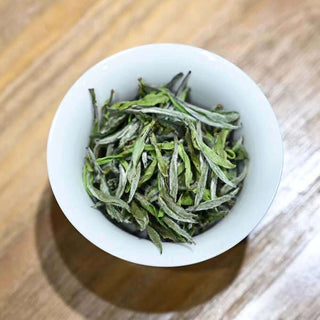
The 357g cake presents a distinguished silver-grey surface with visible white down (Pekoe) covering plump, intact single buds. The compression is moderately firm—tight enough for stable aging, loose enough for easy separation without damaging the delicate buds. Dry aroma reveals immediate complexity: a foundation of sun-dried hay and clean grain evolves into distinct honey sweetness with subtle dried apricot undertone. Eight years of aging have added a gentle woody depth reminiscent of aged cedar, while the signature Pekoe Aroma (Hao Xiang) remains clear and pronounced—like walking through a meadow after light rain.

Wet Leaf (After Brewing)

Spent leaves reveal the quality of material: plump, intact single buds with remarkable uniformity in size. The leaf color has transformed from silver-white to a warm olive-gold, indicating proper aging. Wet leaf aroma intensifies the honey character while introducing notes of osmanthus flower and a whisper of sweet rice. The buds remain supple and fleshy, demonstrating excellent raw material quality and proper storage.

Liquor Color

The tea soup presents a luminous Pale Gold to Warm Amber hue—distinctly deeper than fresh silver needle yet brilliantly clear with no cloudiness. By mid-session, the color deepens to Rich Honey Gold, with remarkable transparency and a subtle oily sheen on the surface indicating high concentration of dissolved compounds. The brightness and clarity confirm clean dry storage with no off-fermentation.

Mouthfeel and Texture

  • Texture: Remarkably Silky and Viscous—the liquor coats the palate with an almost oily richness unexpected in white tea. This is the signature of ancient tree material: deep root systems accessing minerals that translate to substance in the cup.
  • Body: Medium-Full, with noticeable weight and density that builds through subsequent infusions
  • Huigan (Returning Sweetness): Exceptional Duration — A wave of clean sweetness rises from the throat 10-15 seconds after swallowing, persisting for several minutes
  • Sheng Jin (Salivation): Pronounced and immediate, particularly along the sides of the tongue, indicating high amino acid content from ancient tree material
  • Throat Feel (Hou Yun): Deep and penetrating; the sensation reaches well into the throat, a hallmark of aged ancient tree teas

Core Flavor Notes

Primary Notes:

  • Wild Honey (not cloying, but clean and floral-tinged)
  • Sweet Grain / Malted Barley
  • Dried Apricot and Stone Fruit

Secondary Notes:

  • Osmanthus Flower
  • Light Sandalwood
  • Toasted Almond
  • Subtle Jujube (emerging after 5th infusion)

Tertiary Notes (Later Infusions):

  • Gentle Medicinal Herb (in the background, not dominant)
  • Clean Aged Wood
  • Sweet Hay

Flavor Comparison: The profile sits between a well-aged Riesling Spatlese (for its honey-stone fruit character with balancing freshness) and a light Sauternes (for its concentrated nectar quality without excessive heaviness). Coffee enthusiasts may find parallels to a single-origin Ethiopian natural process at light roast—fruited sweetness with floral lift.

Empty Cup and Finish

The emptied cup retains remarkable aromatic persistence: warm honey and osmanthus linger for several minutes, transitioning gradually to a clean woody-sweet base note. The finish in the mouth is exceptionally long—sweetness continues to pulse in the throat for 3-5 minutes after the final sip. There is no astringency, no bitterness, just clean sustained sweetness that invites the next infusion.

Body Sensation (Chaqi / Tea Energy)

  • Intensity: 4/5
  • Character: This tea produces a pronounced calming warmth that begins in the chest and spreads gradually through the body. Many drinkers report gentle perspiration along the back and a distinctive "settling" sensation—a release of tension in the shoulders and jaw. The effect is grounding rather than stimulating: ideal for meditation, focused work, or unwinding after a demanding day.
  • Mindfulness Quality: Ancient tree white tea of this age and quality encourages present-moment awareness. The complexity rewards slow, attentive drinking—each infusion reveals new dimensions, training the palate and focusing the mind.

Brewing guide

Brewing Guide

Gongfu Method (Recommended for Optimal Experience)

This traditional Chinese approach maximizes the tea's complexity across multiple infusions, revealing different flavor dimensions with each steep.

Parameters:

  • Tea Amount: 5-7 grams per 100ml vessel capacity
  • Water Temperature: 95-100 degrees Celsius (just off boil; very hot water best extracts aged white tea's developed compounds)
  • Vessel: Porcelain Gaiwan (preferred for neutrality and heat retention) or Yixing clay teapot dedicated to white tea

Steps:

  1. Rinse your gaiwan with boiling water to preheat; discard water
  2. Add dry leaf; close lid for 10 seconds to appreciate dry leaf aroma in warmed vessel
  3. Pour hot water in circular motion to evenly wet all leaves
  4. First rinse: steep 3-5 seconds, discard (this "awakens" the compressed tea)
  5. First drinkable infusion: 8-10 seconds; pour completely into fairness pitcher
  6. Second and third infusions: 5-8 seconds each
  7. Fourth through seventh infusions: 10-15 seconds each
  8. Eighth infusion onward: add 5-10 seconds per steep as leaves tire
  9. Continue until flavor fades (typically 12-18 infusions with quality ancient tree material)

Tips:

  • Pour decisively and drain completely; do not leave water sitting on leaves between infusions
  • The leaves expand significantly; account for this when dosing
  • Save spent leaves to observe quality—plump intact buds indicate authentic ancient tree single-bud material

Grandpa Style (Simple Daily Drinking)

A casual approach suitable for office or travel, sacrificing some precision for convenience.

Parameters:

  • Tea Amount: 3-4 grams per 300-400ml tall glass or large mug
  • Water Temperature: 90-95 degrees Celsius
  • Vessel: Heat-resistant glass or ceramic mug

Steps:

  1. Place dry leaf directly in drinking vessel
  2. Add hot water, filling vessel approximately 70%
  3. Allow to steep 3-4 minutes for first drink
  4. Drink down to approximately one-third remaining
  5. Refill with hot water; repeat throughout day
  6. Aged white tea tolerates extended contact with water better than green or fresh white teas

Western Style (Larger Portions, Fewer Infusions)

Familiar method for those transitioning from Western tea traditions.

Parameters:

  • Tea Amount: 3-4 grams per 200ml teapot
  • Water Temperature: 95 degrees Celsius
  • Vessel: Ceramic or glass teapot with removable infuser

Steps:

  1. Preheat teapot with hot water; discard
  2. Add measured tea to infuser basket
  3. Pour water over leaves; steep 2-3 minutes for first pot
  4. Remove infuser completely after target time
  5. Second infusion: 3-4 minutes
  6. Third infusion: 5-6 minutes
  7. Expect 3-4 quality infusions with this method

Simmering Method (For Deep, Medicinal Extraction)

Traditional method especially suited to older white tea, extracting maximum body and therapeutic character.

Parameters:

  • Tea Amount: 5-7 grams per 500ml water
  • Water Temperature: Bring to boil, then maintain gentle simmer
  • Vessel: Glass, ceramic, or stainless steel pot (avoid iron which affects flavor)

Steps:

  1. Bring water to rolling boil
  2. Add dry leaf directly to pot
  3. Return to boil, then immediately reduce to lowest heat
  4. Maintain gentle simmer for 5-10 minutes
  5. Turn off heat; let rest 2 minutes
  6. Strain into serving vessel
  7. Leaves may be simmered again with fresh water for second extraction
  8. This method produces a deeply warming, soup-like liquor ideal for cold weather or evening relaxation

Storage

Storage Guide

Proper storage is essential for preserving quality and enabling continued positive transformation.

Essential Storage Principles

Do:

  • Store in a cool, dry location with stable temperature (ideally 15-28 degrees Celsius)
  • Maintain moderate humidity (50-70% relative humidity)
  • Keep in darkness or low-light conditions
  • Allow minimal air exchange for continued aging (avoid completely airtight containers for long-term storage)
  • Store away from strong odors (tea absorbs surrounding scents readily)
  • Use dedicated storage—a clean cardboard box, ceramic jar, or purpose-made tea storage vessel
  • Keep original wrapper intact if storing the full cake
  • Check periodically (every few months) for any signs of mold or off-odors

Do Not:

  • Never store in refrigerator or freezer — The humidity fluctuations, temperature shock, and odor contamination in refrigerators are catastrophic for aged white tea. This is perhaps the most common storage mistake among Western consumers.
  • Never expose to direct sunlight
  • Never store near spices, coffee, cleaning products, or anything aromatic
  • Never use plastic bags for long-term storage (plastic can impart flavor and does not breathe)
  • Never store in excessively humid environments (above 80% RH) without monitoring

Common Storage Mistakes to Avoid

Many tea enthusiasts unknowingly damage valuable aged tea through well-intentioned but incorrect storage:

  1. Refrigerator Storage: Frequently recommended for green teas, this advice does not apply to white tea intended for aging. Cold temperatures halt beneficial transformation, and refrigerator environment introduces moisture damage and odor contamination.
  2. Completely Sealed Containers: While protecting from external odors is important, white tea needs minimal oxygen exchange to continue aging. Vacuum sealing or completely airtight containers stop transformation.
  3. Inconsistent Conditions: Moving tea frequently between environments causes condensation and inconsistent aging. Choose one appropriate location and leave the tea undisturbed.
  4. Storage With Other Tea Types: Different tea categories (especially Puerh with its active microbial processes) should not share storage space with white tea to avoid cross-contamination of aromas and potential unwanted microbial transfer.

Ideal Setup: A dedicated wooden shelf or cabinet in a climate-controlled room, away from windows and kitchen activities. The original paper wrapper and bamboo packaging (if provided) can remain in place. For larger collections, food-grade cardboard boxes lined with clean paper provide excellent economical storage.

Aging Potential: This tea is currently at an excellent drinking stage with significant remaining potential. Under proper conditions, ancient tree white tea of this quality will continue developing complexity for another 10-20+ years, with flavonoid compounds slowly oxidizing into increasingly mellow, honeyed character.

Packaging & use

Scan the QR code on the label for tea details and brewing instructions.

Session estimates use a fresh portion of dry tea each time. Each portion can be infused repeatedly.

Customer reviews

Tracked shipping

Tracking after dispatch. Rates & delivery estimates

14-day returns

Request within 14 days; tea must remain sealed. Conditions apply

Here to help

Order or delivery issue? Contact our support team.