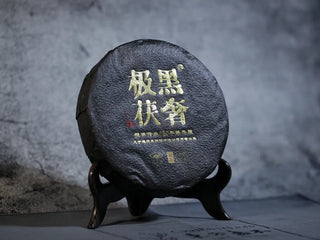
Mellow sweetness, a silky texture and gently woody notes. Golden-flower Fu brick tea made with Yunnan Fengqing leaves.
Choose your size
Try a 30g sample, or choose a 500g brick in black or red packaging. The sample price applies to 30g, not a full brick.
Five years of meticulous aging transforms first-grade Yunnan leaves into a velvety Golden Flower Fu Brick Tea with mellow sweetness and a gently woody character.
-
First-Grade Leaves, Minimal Stems (Under 5%): While standard Fu tea allows up to 20% stems, this tea delivers exceptional smoothness and refined flavor from premium one-bud-one-leaf and one-bud-two-leaf pickings.
-
5-Year Pre-Pressing Aging: Raw materials aged five years in Xi'an dry storage before Fā Huā (发花, "flowering"), transforming harsh edges into mellow depth unavailable in fresh-pressed bricks.
-
Yunnan Large-Leaf Base: Unlike traditional Hunan or Shaanxi-sourced Fu teas, this uses bold Yunnan Fengqing maocha, creating a richer body and more complex flavor architecture.
-
2015 Milan World Expo Gold Medalist: From the same factory recognized on the world stage, representing Xianyang—the birthplace of Fu Brick Tea since the Ming Dynasty.
-
Clean-Room Flowering Technology: Pioneering hygienic production methods ensure abundant, evenly distributed Golden Flowers without contamination concerns.
The name "1958" carries a poignant chapter of Chinese tea history. Originating in Jingyang, Shaanxi, Fu Brick Tea is now produced in both Shaanxi and Hunan, with each region offering its own distinct flavor profile. In 1958, the Chinese government consolidated all Fu tea production to Hunan for economic efficiency, halting centuries of Shaanxi craftsmanship. This tea honors that interrupted legacy—crafted using authentic 1958-era recipes from the original Xianyang People's Fu Tea Processing Factory, revived when Shaanxi production resumed in the early 2000s.
"On Taoism" (几于道) draws its philosophy from Laozi's Tao Te Ching : the highest virtue flows like water—nourishing all things without contention. They pioneered the use of South China tea-growing regions for Fu production, dramatically elevating flavor and liquor quality compared to traditional Qinling Mountain materials.
What truly distinguishes this brick is its journey before pressing. The Yunnan Fengqing maocha—harvested in Spring 2020 at first-grade quality—spent five years slowly transforming in Xi'an's ideal dry climate. Fresh brick has a vibrant aroma from the Golden Flowers. This extended maturation strips away the aggressive, vegetal bite of young dark tea, leaving behind a foundation of mellow sweetness ready for the critical Fā Huā process.
The golden-flower fermentation process helps develop the tea's distinctive flavor. When the aged leaves finally entered the temperature-controlled flowering room in 2025, the Golden Flowers bloomed abundantly throughout the brick—not just on the surface—creating the signature transformation from rough maocha to silky, sweet, gently woody liquor. The result bridges two tea-producing powerhouses: Yunnan's bold leaf character married to Jingyang's ancient fermentation mastery.
- Orientaleaf’s Golden Flower Fuzhuan-Shou entry, made by On Taoism, was a joint winner of the Superior Leaf Award in the Pu-erh category at the 2025 Global Tea Championship. This award belongs to that named entry, not every product from the producer.
- 2015 Milan World Expo "China Famous Tea Gold Award" recipient
- Produced in a modern clean-room facility with strict quality controls
This 1958 Premium Golden Flower Fu Brick Tea represents a rare convergence—Yunnan's finest Spring harvest, five years of patient dry aging, and Jingyang's time-honored flowering craft. With limited production and exceptional raw materials, this is the Fu tea for discerning collectors who understand that true quality cannot be rushed.
The national standard permits up to 20% stems in Fu tea—necessary for air circulation during flowering but often resulting in thinner flavor and woody astringency.
While Hunan Fu tea tends toward floral-sweet and Qinling versions lean mineral-herbaceous, this Yunnan-based production delivers the best of both—bold structure with refined elegance.
The year 1958 marks a pivotal—and bittersweet—moment in Fu tea history.
Shaanxi's workshops fell silent, and the region's unique techniques faced extinction.
Explore All On Taoism Fu Tea →
All Fu Brick Tea →