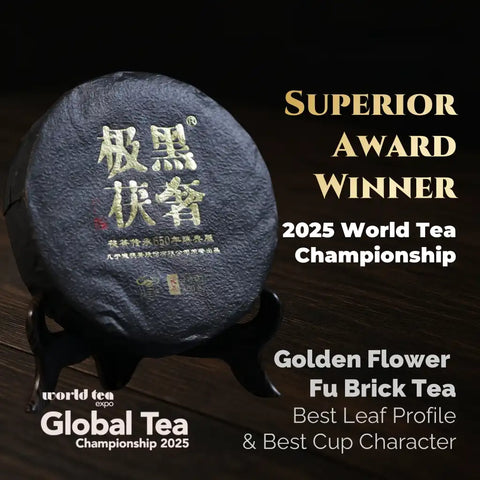
This section covers the flavor profiles of all three estate styles included in this box. Because the nine samples span multiple terroirs, base materials, and aging stages, we have organized the flavor notes by estate grouping. Use these profiles as your tasting guide.
On Taoism Style — Yunnan Large-Leaf & Fujian White Tea Fu Brick
Appearance & Aroma (Dry)
The On Taoism bricks are pressed at a moderate-to-firm density. The surface reveals a dark olive-brown color with clearly visible golden-yellow specks of 金花 (Jīn Huā) scattered densely throughout. The dry aroma opens with a clean, warm fungal note — earthy mushroom, dried longan, and a background sweetness similar to roasted grain. The Baicha Fuzhuan (white tea base) expresses a noticeably lighter, more floral dry aroma: dried chrysanthemum, white peach skin, and a faint honey note.
Wet Leaf
After rinsing and the first steep, the Yunnan-base leaves unfurl to show larger, darker leaves typical of Yunnan large-leaf varieties — dark brown with occasional reddish-amber edges, largely intact. The wet aroma is warm and inviting: cooked mushroom broth, brown sugar, and a slight camphor lift. The Baicha Fuzhuan wet leaf is lighter in color — caramel tan — with a honeyed, floral aroma that is closer to aged white tea than a traditional dark tea.
Liquor Color
- Yunnan expressions (Fengqing / Lincang): Deep amber-orange, clear and bright
- Baicha Fuzhuan: Light golden-amber, translucent and luminous
Mouthfeel
Full-bodied and coating for the Yunnan expressions — a texture that sits between a well-pulled espresso and a medium-bodied red wine. The liquor has a slight oiliness on the palate, with a sweetness that builds in the mid-palate and a clean, pleasant return sweetness (回甘, Huígān) that lingers 30–60 seconds after swallowing. The Baicha Fuzhuan is lighter, silkier — more like a floral oolong in texture, with a very sweet, clean finish.
Core Flavor Notes
- Yunnan Fengqing expression: Roasted chestnut, dried longan, mushroom umami, dark caramel, a hint of pine resin
- Yunnan Lincang expression: Dried red dates (jujube), cooked grain, molasses, light tobacco leaf, mineral earth
- Baicha Fuzhuan (Fu Xi & Fu Bao): Wildflower honey, dried apricot, light vanilla, fresh cream, soft fungal note
Empty Cup & Finish
The empty cup retains a warm, roasted-sweet aroma for several minutes — reminiscent of the interior of a specialty coffee roastery. The finish on the Yunnan expressions is long and warming, with a persistent sweet-earthy note. The Baicha Fuzhuan finish is shorter but more delicate — clean and floral, with a lingering honey quality.
Body Sensation / Chaqi (茶气, Chá Qì)
- Warming sensation across the chest and stomach; gentle perspiration on the palms and upper back after 3–4 steepings
- The Yunnan large-leaf base material produces a notably energetic chaqi — alert and grounding simultaneously
- Chaqi Intensity: 3.5 / 5
YXT Style — Qinling Mountain Fu Brick
Appearance & Aroma (Dry)
YXT bricks are compressed firmly and evenly. The surface is dark brown with a slight reddish hue in the finer-grade Ximanzi and Guotai bricks. Golden Flowers are clearly present and dense in the Guotai; well-distributed in all three. The dry aroma is clean and mineral-forward — dried autumn leaves, a hint of cedar wood, and a soft fungal note with no off-scent. The Qinling terroir expresses itself in a clean, mountain-air quality that distinguishes these bricks from Yunnan-base Fu Zhuan.
Wet Leaf
Leaves are moderately sized, dark brown, with a notably low stem content in the Ximanzi and Guotai grades — a direct reflection of the premium-grade raw material selection (特级原料, Tèjí Yuánliào). The Dabashan expression shows slightly older, more mottled leaf surfaces consistent with 2016-2017 material pressed in 2018. Wet aroma: damp forest floor, fresh earth, dried jujube, and a clean woody backbone.
Liquor Color
- Ximanzi: Warm amber, clear and bright, with a light gold rim
- Dabashan: Deep amber-brown, slightly darker than Ximanzi, reflecting its early-aged character
- Guotai: Rich amber-mahogany, full and deep
Mouthfeel
YXT teas are characterized by a smooth, round mouthfeel — mellow rather than sharp, with no rough edges. The Guotai in particular has a velvety, coating texture that stays on the palate for an extended period. Sweetness is moderate and clean. The signature mineral finish (矿物余味, Kuàngwù Yúwèi) — a dry, stone-like quality on the back of the palate — is a hallmark of the Qinling mountain terroir and is most pronounced in the Guotai.
Core Flavor Notes
- Ximanzi: Dried grass, green walnut, light honey, clean mineral water, hints of dried white chrysanthemum
- Dabashan: Dark plum, aged wood, soy caramel, damp earth, mild camphor, mineral rock
- Guotai: Roasted barley, dried tangerine peel, dark honey, worn leather, clean slate mineral
Empty Cup & Finish
The Qinling mineral terroir leaves a clean, lingering dry-mineral note in the empty cup — subtle but identifiable. The finish is medium-long, settling into a gentle sweetness. No lingering bitterness or astringency.
Body Sensation / Chaqi (茶气, Chá Qì)
- Steady, grounding warmth radiating from the stomach outward; calming rather than stimulating; well-suited for extended, contemplative tea sessions
- Chaqi Intensity: 3 / 5
Genshe Style — Traditional Shaanxi Fu Zhuan, Aged 6–15+ Years
Appearance & Aroma (Dry)
Genshe bricks are hand-pressed at a slightly looser density compared to machine-pressed competitors, which facilitates a more even and deeper aging process. The surface of the 2010 and 2014 bricks shows a mature dark-chocolate brown color with a matte, aged surface; Golden Flowers remain clearly visible. The 2019 is slightly darker and more uniform. Dry aroma on the 2010: aged plum, dark chocolate, faint incense wood. The 2014 sits between complexity and accessibility: dried fig, roasted coffee, gentle earthiness. The 2019: clean dark earth, dried mushroom, a light sweetness.
Wet Leaf
All three Genshe bricks use Hunan Anhua Hei Mao Cha (黑毛茶, Hēimáo Chá) as the base. The wet leaf on the 2010 is a uniform, deep reddish-brown — leaves are largely intact, soft, and show excellent aging consistency. The 2014 is similarly well-aged with a slight burgundy tone. The 2019 is darker and more robust-looking. Wet aroma across all three: warm baked plum, dark earth, cacao, and a clean forest floor note with no mustiness.
Liquor Color
- Genshe 2019: Deep amber, clear
- Genshe 2014: Dark amber-mahogany, rich and luminous
- Genshe 2010: Dark garnet-brown, deep and opaque at full concentration — evocative of a well-aged tawny port
Mouthfeel
This is where Genshe is most distinctive. The mandatory 4-year minimum aging before release — combined with well over a decade of total aging in the 2010 vintage — produces a texture that is genuinely velvety and oil-coating on the palate. There is no astringency and virtually no bitterness. The sweetness is not a sharp sugar sweetness — it is deep, rounded, and persistent, more like a well-aged balsamic vinegar or a quality aged rum, where the natural sugars have transformed and mellowed over time. Return sweetness (回甘, Huígān) on the 2010 and 2014 can last 2–3 minutes.
Core Flavor Notes
- Genshe 2019: Dark plum jam, cooked red dates, dried mushroom, mild dark chocolate, clean earth
- Genshe 2014: Roasted coffee, dried fig, aged wood, dark caramel, a hint of vanilla, soft leather
- Genshe 2010: Aged dark chocolate, Chinese herbal medicine (licorice, aged citrus peel), dried longan, incense wood, stone fruit, faint camphor — this cup has the complexity of a well-aged Bordeaux
Empty Cup & Finish
The Genshe teas leave the most persistent empty-cup aroma of all three estates. The 2010 empty cup retains a warm, dried-fruit-and-dark-wood aroma for 5–10 minutes. The finish is extraordinarily long and sweet — the sweetness of aged Anhua Hei Mao Cha at full maturity is unlike anything else in the Fu Zhuan category.
Body Sensation / Chaqi (茶气, Chá Qì)
- Deep, strong warming sensation throughout the torso; gentle perspiration; a sense of calm mental clarity that builds over the session
- The 2010 vintage, in particular, produces a notably deep and grounding chaqi — comparable to the body sensation associated with well-aged raw pu-erh
- Chaqi Intensity: 4 / 5 (2019), 4.5 / 5 (2014), 5 / 5 (2010)