


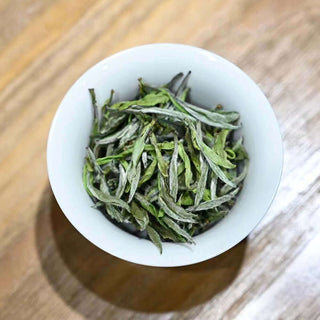


Comment Infuser du Thé Blanc Fuding
Le thé blanc Fuding est facile à infuser, mais la bonne approche permet de révéler tout son caractère. Les variables clés sont la température de l'eau, le récipient et le ratio feuilles/eau — et celles-ci varient en fonction du grade et de l'âge du thé que vous utilisez.
Un point de départ pratique :
- Aiguille d'Argent (en vrac) : Utilisez 3g de thé pour 150ml d'eau à 85°C (185°F). Laissez infuser la première infusion pendant 45 à 60 secondes.
- Bai Mu Dan (en vrac) : Utilisez 5g de thé pour 100ml d'eau à 88°C (190°F). Laissez infuser la première infusion pendant 30 à 45 secondes.
- Shou Mei (en vrac) : Utilisez 5g de thé pour 100ml d'eau à 90–95°C (194–203°F). Laissez infuser la première infusion pendant 30 secondes.
- Galette vieillie (3+ ans) : Utilisez 6g de thé pour 100ml d'eau à 95–100°C (203–212°F). Laissez infuser la première infusion pendant 20 à 30 secondes.
Deux méthodes fiables :
- Gaiwan (style Gongfu) — Idéal pour l'Aiguille d'Argent et le Bai Mu Dan. Utilisez des infusions courtes et partagez sur plusieurs infusions. Une bonne Aiguille d'Argent donnera 6 à 8 infusions avant de s'estomper.
- Tasse ou mug (style occidental) — Convient bien pour le Shou Mei de tous les jours. Utilisez 2 à 3g pour 250ml, laissez infuser 2 à 3 minutes, et réinfusez une ou deux fois.
Une règle s'applique à tous les grades : évitez l'eau bouillante pour les thés frais ou riches en bourgeons. Les trichomes fins qui donnent son caractère à l'Aiguille d'Argent sont sensibles à la chaleur — une température excessive aplatit la douceur et fait ressortir une amertume indésirable.
Pour les galettes vieillies et le Shou Mei, l'eau bouillante n'est pas seulement acceptable — elle est préférable. Les feuilles compressées ont besoin de la chaleur pour s'ouvrir correctement.
→ Pour une explication complète par grade et récipient, consultez notre [Guide d'Infusion du Thé Blanc Fuding].
Récolte de printemps ou récolte d'automne — quelle est la différence ?
Les thés de printemps et d'automne figurent tous deux dans cette collection, et la différence entre eux est réelle et mérite d'être comprise avant de faire votre choix.
La récolte de printemps (fin mars – mai) est la référence. Après des mois de dormance, la plante de thé concentre son énergie dans la première pousse de nouvelles feuilles. Les bourgeons de printemps sont plus charnus, plus denses en acides aminés, et possèdent un caractère plus vif, plus doux et plus distinctement floral. Le Silver Needle de printemps est l'expression la plus claire de ce que le thé blanc de Fuding peut être à son plus raffiné. Pour le Silver Needle et le Bai Mu Dan de qualité supérieure, la récolte de printemps est presque toujours le choix préféré.
La récolte d'automne (août – octobre) produit une expression différente mais tout aussi valable. La saison de croissance prolongée donne des feuilles avec un profil plus rond, plus doux — moins intensément floral, plus chaleureusement sucré, parfois avec de subtiles notes fruitées ou miellées même jeunes. Le Shou Mei d'automne en particulier est depuis longtemps apprécié pour sa richesse naturelle et son aptitude à être pressé en galettes. De nombreux buveurs expérimentés préfèrent activement les thés d'automne pour la consommation quotidienne : plus doux dès le départ, moins délicat, plus immédiatement satisfaisant.
Un guide pratique :
- Nouveau dans le thé blanc de Fuding ? Commencez par le Bai Mu Dan de printemps – c'est l'expression la plus représentative.
- Vous cherchez un thé pour tous les jours ? Le Shou Mei d'automne offre plus de corps et de chaleur à un meilleur prix.
- Vous constituez une collection vieillissante ? Les récoltes d'automne, en particulier les galettes de Shou Mei, sont un choix bien établi parmi les collectionneurs.
Chaque description de produit de cette collection indique clairement la saison de récolte, vous savez donc toujours ce que vous achetez.
Thé frais ou thé vieilli : choisir en fonction de l’année
L'année de récolte indiquée sur chaque produit n'est pas seulement une information chronologique, elle est aussi essentielle pour comprendre le caractère du thé.
Le thé blanc de Fuding frais (0–2 ans) est synonyme de luminosité et de clarté. Le Young Silver Needle est délicat et pur, avec une subtile douceur et une sensation de fraîcheur en gorge. Le Young Bai Mu Dan est floral et vif. Ce sont des thés que l'on boit pour apprécier le caractère brut de la feuille, de la saison et du terroir. Manipulez-les avec soin — températures légères, infusions courtes et attention aux détails.
Le thé modérément vieilli (3–5 ans) a entamé sa transformation. Les notes herbacées et florales s'adoucissent. Elles sont remplacées par une chaleur miellée, des fruits secs — des notes d'abricot ou de longane — et une sensation en bouche nettement plus pleine et plus douce. C'est souvent à cette période que le thé blanc devient réellement complexe : toujours reconnaissable, mais avec une nouvelle profondeur.
Le thé profondément vieilli (7+ ans) est une boisson complètement différente. La liqueur s'intensifie jusqu'à devenir ambre ou orange brûlé. Les saveurs s'orientent vers un registre riche — jujube séché, feuille de lotus, herbes médicinales, miel foncé, parfois une note boisée nette. La sensation en bouche devient exceptionnellement douce et épaisse. Ce sont les thés décrits dans le proverbe chinois : 一年茶,三年药,七年宝 — « un an un thé, trois ans un médicament, sept ans un trésor. »
Cette collection s'étend sur plusieurs années de récolte. Si vous souhaitez découvrir l'évolution complète en un seul achat, optez pour nos kits d'échantillons multi-années. Si vous avez un âge spécifique en tête, filtrez par année de récolte.
→ Vous voulez comprendre le processus de vieillissement en profondeur ? Lisez notre [Guide sur le vieillissement du thé blanc de Fuding].
Comment conserver le thé blanc Fuding
Le thé blanc n'est pas fragile, mais il est sensible. Le traitement minimal qui lui confère une saveur si pure et naturelle signifie également qu'il y a moins de tampons chimiques entre la feuille et son environnement. Un stockage approprié fait la différence entre un thé qui conserve son caractère pendant des années et un autre qui s'aplatit en quelques mois.
Les cinq choses à contrôler :
- Lumière — L'exposition aux UV dégrade rapidement les composés aromatiques de la feuille. Gardez le thé à l'abri des fenêtres et de la lumière artificielle intense.
- Air — L'oxygène est le moteur de l'oxydation. Utilisez un emballage hermétique ; refermez complètement les sacs après chaque utilisation.
- Humidité — Une humidité élevée est l'ennemi de la fraîcheur et la cause de saveurs désagréables et de moisissures. Visez une humidité relative inférieure à 60 %.
- Chaleur — Des températures stables et fraîches préservent l'arôme. Gardez le thé à l'écart des fours, des radiateurs et du soleil direct.
- Odeur — Les feuilles de thé absorbent facilement les odeurs environnantes. Ne les stockez jamais à proximité de café, d'épices ou de produits de nettoyage.
Pour les thés frais : Une boîte opaque et hermétique ou une pochette en aluminium à double scellage, rangée dans une armoire fraîche, sombre et sans odeur, est suffisante. La température ambiante convient, mais le réfrigérateur n'est pas recommandé pour le thé à usage régulier en raison du risque de condensation lors de la sortie.
Pour les galettes de vieillissement : L'approche change. Le vieillissement exige un certain degré de respirabilité — vous invitez une transformation lente et contrôlée, plutôt que de l'exclure. Un espace propre, sans odeur, avec une humidité modérée (60–75 % HR), une circulation d'air douce et sans lumière directe est l'approche de stockage classique de Fuding. Les étagères en bois dédiées ou les boîtes en carton respirantes fonctionnent bien. L'objectif est un environnement stable et tranquille où le thé peut se développer au fil des ans sans interruption.
→ Guide complet sur le stockage du thé frais et le vieillissement à long terme : [Guide de stockage du thé blanc].