


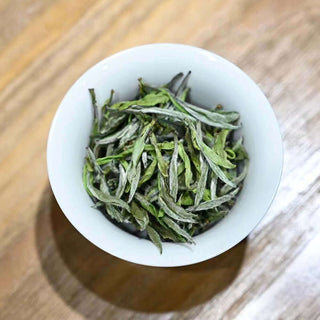


What Is Shou Mei (寿眉)?
Shou Mei means "Longevity Eyebrow" — the name comes from the curled, arching shape of the dried leaves, said to resemble the long brows of a wise elder, a traditional symbol of long life in Chinese culture. Under China's national white tea standard (GB/T 22291–2017), it is the fourth and most abundant grade of Fuding white tea, made from mature leaves and tips picked in late spring after Silver Needle and White Peony harvests are complete. The leaves are larger, broader, and naturally richer in polysaccharides and natural sugars than the finer grades above it.
That composition is precisely why Shou Mei ages so well. The same compounds that make it look rustic when young are the ones that transform over years into the warm sweetness, honeyed depth, and eventual medicinal character — 药香 (yào xiāng) — of a mature aged cake. It is the grade most commonly pressed into cakes and bricks, the one most worth buying in quantity and storing at home.
"一年茶,三年药,七年宝" — One year a tea, three years a medicine, seven years a treasure. This saying comes from Fuding. It was written with Shou Mei in mind.
Where Shou Mei Fits: The Four Grades of Fuding White Tea
All four grades come from the same Fuding tea plants — Fuding Dabai and Fuding Dahao cultivars. What separates them is when the shoot is picked and how much of it is included.
| Grade | Plucking Standard | Harvest Time | Young Flavor | Aged Flavor | Best For |
|---|---|---|---|---|---|
| Silver Needle | Unopened buds only | Early spring | Delicate, sweet, melon, fresh hay | Honeyed, floral complexity | Special occasions, gifting |
| Bai Mu Dan | Bud + 1–2 young leaves | Mid-spring | Floral, fuller body, sweet soy-milk | Dried apricot, honey, herbal warmth | Daily drinking, newcomers |
| Gong Mei | Bud + more mature leaves | Late spring | Fruity-sweet, bold, hay-like | Date sweetness, rich amber cup | Daily drinking, transitional grade |
| Shou Mei ← you are here | Mature leaves + stems | Late spring / autumn | Herbaceous, earthy-sweet, bold | Dried dates, 药香 depth, woody warmth | Aging, collecting, robust daily use |
Sun-Dried vs. Indoor-Withered: Why Processing Matters for Aging
Most of the cakes in this collection are sun-dried (日晒). This is the traditional Fuding method: freshly picked leaves are spread on bamboo trays and withered under direct sunlight rather than in a climate-controlled shade room. The difference becomes meaningful over years of aging.
| Method | Character When Young | Character After Aging |
|---|---|---|
| Sun-dried (日晒) Withered under direct sunlight outdoors |
Bolder, slightly more oxidized, warm sweetness, heavier body | Thicker, darker liquor; rich date and honey depth; warming, rounded character |
| Indoor-withered (室内萎凋) Withered on shaded, ventilated racks |
Lighter, cleaner, more restrained; delicate initial profile | More floral notes linger; mellow rather than deep; less body, more elegance |
Neither is objectively better — they suit different preferences. For depth and aging potential, sun-dried material has a structural head start. Where it is relevant, the withering method is noted on each product page.
How Shou Mei Changes Over Time
The transformation is gradual and consistent: away from green and herbaceous, toward sweet, warm, and medicinal. Here is a rough guide to what to expect at different stages.
Timelines vary with storage conditions. These descriptions assume dry storage at stable room temperature — the same environment we use in Xi'an.
Three Teas Across the Aging Arc
Fourteen teas in this collection span 2013 to 2024, covering fresh spring harvests, mid-aged daily drinkers, and 10-year-old cakes. These three represent the main stages of the journey.
Spring 2021, Guanyang Town, Fuding. Fuding Dahao cultivar, sun-dried, loosely pressed — breaks apart by hand with no tools needed. Deep reddish amber liquor, clear dried-date sweetness, full body. Sitting comfortably in early-aged territory with no raw edges. A low-commitment way to start with aged Shou Mei.
Shop Now →Late spring 2018, Xitou village, Guanyang. Sun-dried Fuding Dahao, pressed 2023 after five years of loose-leaf aging. Date sweetness clearly present, warming character, medicinal depth beginning to build. Drinks well now and continues to develop in storage. A 30g sample is available before committing to a full cake.
Shop Now →Late spring 2014, Xitou village. Fuding Dabai & Dahao, sun-dried, pressed 2016. Over a decade of aging: dried jujube, 药香 medicinal depth, nothing raw left. 18 break-apart sections (~5.5g each) — one section, one gongfu session. Runs 12+ steeps. No tools required.
Shop Now →How to Choose
Fourteen options is more than most people need at once. A few questions that help narrow it down:
Brewing Shou Mei
Shou Mei handles heat better than Silver Needle or White Peony. Use boiling or near-boiling water — lower temperatures leave the body thin and the sweetness underdeveloped. The mature leaf is naturally forgiving: extended steeping won't produce the bitterness you'd get from a green tea.
For compressed cakes, a quick rinse (5–10 seconds, boiling water, discard) before the first steep helps loosen the leaf and open up the aroma.
| Method | Water Temp | Leaf / Water | First Steep | Subsequent Steeps | Notes |
|---|---|---|---|---|---|
| Gongfu — Young (1–3 yr) | 90–95 °C | 5g / 100 ml | 25–35 sec | +10 sec each | 7–9 steeps. Slightly lower temp preserves what freshness remains. |
| Gongfu — Aged (4+ yr) | 95–100 °C | 5g / 100 ml | 20–30 sec | +10–15 sec each | 10–12+ steeps. Full boil opens date sweetness and medicinal depth fully. |
| Western / Pot | 95–100 °C | 3–4g / 300 ml | 3–4 min | +1 min each | 2–3 infusions. Good for mornings or when a gongfu setup isn't practical. |
| Grandpa / Mug | 95–100 °C | 2–3g / 250 ml | Drink as it steeps | Refill when ⅓ remains | The low bitterness of aged Shou Mei makes it exceptionally forgiving for long-steep drinking. |
| Cold Brew | Cold water | 4–5g / 500 ml | 8–12 hrs, refrigerated | — | Fresh or lightly aged Shou Mei works best. Naturally sweet, no bitterness. |
Storing and Aging Shou Mei at Home
Shou Mei is the most forgiving of white teas to store. Keep it away from light, moisture, strong odors, and temperature swings. A sealed ceramic jar or layered foil bag inside a dark cupboard works well. Avoid the refrigerator — condensation when you take the tea out does more harm than good.
For long-term aging, compressed forms (cakes, bricks) are preferable to loose leaf. The density creates a stable micro-environment for slow, even transformation. If you buy a tong of seven cakes, open one periodically — Shou Mei changes noticeably in 18–24 month intervals.
All teas here have been dry-stored in Xi'an since sourcing. Xi'an's low humidity keeps the flavors clean and the leaf intact — no mustiness, no off-notes. See how we store it →
For a full guide to storage conditions, containers, and the difference between aging-forward and freshness-forward approaches: How to Store White Tea: Keep It Fresh or Let It Age →
The White Tea Family
Shou Mei is the boldest and most age-worthy grade. Its relatives share the same Fuding origin and minimal processing but occupy a completely different part of the flavor spectrum.
Pure buds only — the most delicate grade. Thin, sweet, clear melon and hay notes. Dense silver-white fuzz on every needle. Best for special occasions, gifting, or quiet attentive drinking.
Browse Silver Needle →Bud plus one or two young leaves. The balanced grade — floral, fuller-bodied than Silver Needle, and the natural starting point for most newcomers to Fuding white tea.
Browse White Peony →Silver Needle, White Peony, Shou Mei, and aged vintages from multiple harvests in one place. Useful for comparisons across grades or when looking for something specific.
Browse All White Tea →Further Reading
Origins, the meaning of "Longevity Eyebrow," how aging transforms the flavor year by year, and practical brewing parameters for loose leaf and compressed cakes.
White Tea GuideA direct comparison — appearance, flavor profile, oxidation level, caffeine content, and which grade suits different drinking habits and purposes.
White Tea GuideSilver Needle, White Peony, Gong Mei, Shou Mei — how plucking standard defines each grade, and what that means for taste, body, and long-term aging potential.
White Tea GuideThe complete map of Fuding white tea — terroir, history, national standard grades, flavor across harvests and years, and how to approach brewing each style.
Buying GuideA purpose-driven framework for choosing white tea. Four sensory pillars for judging quality. What vague marketing terms to ignore, and what to actually look for in the leaf.
StorageThe five enemies of fresh white tea, the right containers for each storage goal, why the fridge usually isn't the answer, and the conditions that let Shou Mei age well at home.