





The collection, in depth
White Peony Tea: Choosing Bai Mu Dan by Origin, Leaf Grade and Age
Bai Mu Dan combines a bud with one or two leaves, giving white tea both fragrance and body. Compare the Fuding and Yunnan selections, recent harvests and older cakes, then choose a format and brewing approach that fits the way you drink.
Read the full guide Close the guide
What Is Bai Mu Dan (White Peony)?
What Is Bai Mu Dan (White Peony)?
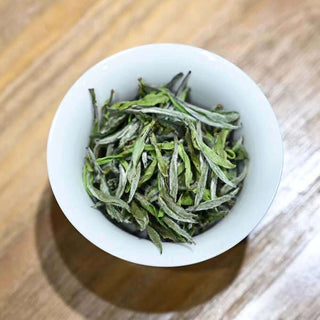
Bai Mu Dan (白牡丹), or White Peony, takes its name from the appearance of a pale bud surrounded by opening leaves. In the traditional white tea description, the picking is a bud with one or two leaves. Those leaves contribute body and a different aromatic balance from a bud-only Silver Needle.
White tea is primarily made by withering and drying, without the fixation used for green tea or the rolling used to promote oxidation in black tea. Oxidation still occurs during withering; it is not deliberately driven to the extensive oxidation associated with black tea. Compressed white tea may also be softened with steam before pressing and dried again.
White Peony can be floral, hay-like, honeyed or gently fruity. Those are useful tasting directions, not a promise that every origin and vintage will be the same. The teas in this collection include Fuding selections from Fujian and a Jinggu selection from Yunnan.
Tea Type Is Not the Same as Quality Grade
White Peony is a product type. A label such as Special Grade, Grade 1, Grade 2 or Grade 3 describes a further grade within that type. It does not mean White Peony itself is “Grade 2” of all white tea.
| Type | Typical raw-material description | What to compare |
|---|---|---|
| Silver Needle | Single buds, with cultivar requirements under the applicable standard | Bud character and a more restrained cup |
| White Peony | A bud with one or two leaves | A balance of aroma and leaf body |
| Gongmei | Tender shoots of seed-propagated local tea populations | The stated cultivar and product standard |
| Shou Mei | Tender shoots or leaves of the specified cultivars or local populations | Leaf maturity, processing and storage |
For the exact grade, origin and raw material of a particular tea, use its own product listing. The familiar market names used for Yunnan white teas should not be read as proof that every product has identical cultivar requirements to a Fuding tea.
Fuding and Jinggu: Compare the Actual Teas
Start with the traditional reference
The Fuding range includes recent cakes and bricks, smaller biscuits and older material. Compare picking grade and processing as well as year; origin alone does not determine how light or full the cup will be.
Explore the Fuding white tea collection →A useful comparison across origins
The 2024 Jinggu White Peony brings a Yunnan selection into the same bud-and-leaf conversation. Brew it beside a Fuding tea to compare fragrance, body and finish without assuming that the region fixes a single flavor.
Explore 2024 Jinggu White Peony →Read more about Yunnan White Peony or compare the broader Yunnan white tea range.
Recent Harvests, Older Leaf and Pressing Dates
A harvest year describes the leaf, while a pressing date describes when it became a cake or brick. They need not be the same. Do not calculate the time spent in Xi’an from a harvest year unless that complete storage history is documented.
Recent White Peony often emphasizes fragrance and a lighter freshness. Older examples can develop deeper honey, fruit or woody notes. Processing, packaging and storage influence that direction, so there is no guaranteed year when a cake becomes sweeter or reaches its peak.
Sun and indoor withering are different ways of managing moisture loss and development. Neither term independently proves superior quality or longer aging potential. The 2018 sun-dried and indoor-withered biscuits offer a practical comparison of the teas themselves.
Six White Peony Teas to Compare
Six White Peony Teas to Compare
 Fuding · Spring 2023White Silk Ray — Fuding Bai Mu Dan White Tea Cake, Spring 2023
A Fuding cake to use as a reference for the bud-and-leaf style. Choose it when you want to explore a single recent-harvest White Peony before comparing older material.
Explore this tea → Fuding · Grade 3 · 200g2023 Fuding White Peony Tea Brick (Grade 3, Spring Harvest) - 200g Hand-Pressed Fujian White Tea
A spring 2023 White Peony brick with its grade clearly stated. Grade 3 is an internal White Peony grade, not a different tea category. Compare its portioning and flavor with the cake formats.
Explore this tea → Jinggu · Yunnan · 2024Yunnan Jinggu White Peony Tea Cake 357g – 2024 Spring Harvest
The Yunnan choice for an origin comparison. Start with the same portion and brewing method as a Fuding tea, then adjust to the flavor rather than assigning a fixed regional hierarchy.
Explore this tea → Fuding · 2018 · Sun-dried2018 Sun-Dried White Peony Fuding Compressed Biscuit
A small compressed format for exploring older White Peony. Pair it with the indoor-withered biscuit if processing is the question you want to investigate.
Explore this tea → Fuding · 2018 · Indoor-withered2018 Indoor-Withered White Peony Fuding Compressed Biscuit
The companion to the sun-dried biscuit. Differences in the cup describe these particular teas; do not treat the comparison as proof that one withering method always ages better.
Explore this tea → Fuding · 2012 leaf · 500gGold Brick 2012 Sun-Dried White Peony Fuding 500g Brick
An older-leaf selection for someone specifically seeking developed White Peony. Read its product details for the distinction between the material year, pressing and storage history.
Explore this tea →How to Choose White Peony
Your first White Peony
Start with White Silk Ray 2023 or the 2023 Grade 3 brick. Choose the currently offered quantity that suits a first comparison.
You want an origin comparison
Try 2024 Jinggu White Peony beside a Fuding tea. Keep water, portion and timing similar for the first round, then adjust each to taste.
You want an older example
Look at the 2014 waffle cake or 2012 Gold Brick. A material year is useful context, not a guarantee of a particular flavor.
You want to compare processing
The two 2018 biscuits let you compare sun-dried and indoor-withered selections without choosing solely by a general theory about processing.
Brewing White Peony
White Peony is adaptable. Leaf amount, water temperature and time work together, so use the table as a starting point and change one variable at a time.
| Method | Leaf and water | Temperature | Starting time |
|---|---|---|---|
| Gongfu | 4–5g / 100ml | 90–95°C | 20–30 seconds, extending as needed |
| Pot or mug | 3g / 250–300ml | 90–95°C | About 3 minutes; taste and adjust |
| Older or tightly pressed leaf | 4–5g / 100ml | 95–100°C if preferred | Start short and watch how quickly the portion opens |
| Refrigerated cold brew | 4–5g / 500ml | Cold water, kept refrigerated | 8–12 hours as a starting point, then strain |
Separate a manageable piece from the edge of a cake. A brief rinse can help open compressed leaf, but it is not a way to make spoiled tea safe or reliably remove caffeine. If the cup is too strong, reduce time or leaf before assuming the tea cannot take hot water.
Keeping White Peony Fresh or Storing It Longer
For everyday use, close the package after each session and keep it away from moisture, heat, light and household odors. Packaging matters as much as the cupboard. Avoid repeated exposure to humid room air, and do not deliberately add moisture to accelerate change.
A cake is convenient to portion and store, while loose leaf can also keep well when properly protected. Compression alone does not guarantee superior aging. Taste stored tea periodically and decide whether you enjoy its direction.
We store our teas in Xi’an under naturally occurring ambient humidity. We do not artificially control humidity. Conditions follow the seasons rather than a fixed humidity target; we keep the tea protected from moisture, direct sunlight and strong odors.
How our natural dry storage in Xi’an works →
White tea storage: keeping freshness and allowing development →
Where White Peony Fits in the White Tea Family
Where White Peony Fits in the White Tea Family
If you prefer a bud-only style, explore Silver Needle. If you want a broader mature-leaf selection, compare Shou Mei. Neither is simply a higher or lower numbered version of White Peony.
For a wider view, browse all white tea, or compare Fuding and Yunnan by origin. White-tea-based Fu bricks with golden-flower fermentation are a distinct further-processed style; read their own process and ingredients rather than treating them as ordinary withered white tea.
This tea contains caffeine. The amount in a cup depends on the leaf, portion size, water temperature and steeping time; the tea category or its age alone does not establish a low-caffeine serving. Use a smaller portion or drink earlier if caffeine affects you.
Further Reading
The bud-and-leaf style, its character and practical ways to approach a first cup.
ComparisonWhite Peony vs. Silver NeedleCompare bud-only tea with a bud-and-leaf style before deciding what to try.
ComparisonWhite Peony vs. Shou MeiA useful comparison when you want more mature leaf or a different balance of body and aroma.
OriginYunnan White PeonyBackground for the Jinggu selection and a comparison with the Fujian range.
StorageKeeping and Storing White TeaPackaging, moisture protection and the different goals of freshness and longer storage.