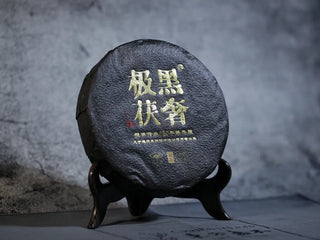
On Taoism has long focused on crafting Fu tea (茯茶) using quality raw leaves from southern China. The Silk Road Black Pearl is an interesting expression of that approach — Yunnan raw Pu-erh material from Lincang, sent to Jingyang in Shaanxi province for the traditional Jin Hua (golden flower) fermentation process, bringing two distinct tea cultures together in a single tea.
"Silk Road" references Xi'an's historical identity as the starting point of the ancient Silk Road. "Black Pearl" is simply a straightforward description of what this tea looks like — tightly hand-rolled dragon pearls, dark and round, each one genuinely resembling a small black pearl.
Origin & Material
| Tea Region |
Bai Ying Shan, Yunnan Lincang |
| Harvest |
Spring 2024 Blended Material |
| Jin Hua Processing Location |
Jingyang, Shaanxi |
| Storage |
Dry warehouse, Xi'an |
Bai Ying Shan (White Eagle Mountain, 白莺山) sits in Yun County, Lincang, along the middle reaches of the Lancang River. It's a tea area known for a relatively diverse range of tea tree varieties. This tea is a blend of several cultivars from the area, including:
-
Er Ga Zi (二嘎子): A wild hybrid transitional variety. Known for its smooth, soft liquor, naturally high sweetness, and low bitterness or astringency.
-
Mengku Da Ye Zhong (勐库大叶种): The classic large-leaf Mengku variety.
-
Mengku Xiao Ye Zhong (勐库小叶种): A smaller-leaf counterpart from the same area.
Bai Ying Shan is not a hyped or speculative single-origin mountain. The material cost is honest, and so is the price.
How It's Made
-
Light Wet Piling (Wo Dui): The raw Pu-erh leaves are moistened to a damp level, then lightly piled for approximately 10 hours of mild fermentation.
-
Steaming & Rolling: The leaves are steamed until soft, then hand-rolled into individual dragon pearl shapes.
-
Jin Hua Fermentation & Drying: The pearls are placed in a climate-controlled fermentation room, where temperature and humidity are carefully managed over approximately 28 days to allow the Jin Hua (冠突散囊菌, Eurotium cristatum) to naturally develop.
One thing worth noting: no external inoculants of any kind were used in this process — no flour, grain, or any other commonly used additives.
Because of the dragon pearl shape, the Jin Hua grows primarily inside the pearl, not on the surface.
Explore All On Taoism Fu Tea →
All Fu Brick Tea →