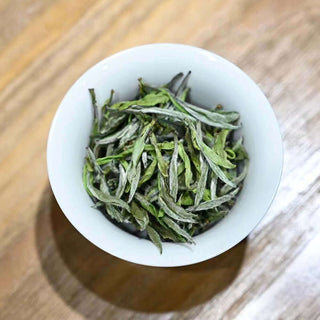
"The dew does not arrive suddenly. It gathers overnight, quietly, on the leaves — and by morning the world is covered in a thin, silver patience. This is the season's first honest hint that summer is gone. And somewhere in the hills, a tea waits to meet it."
Key Takeaways
- What White Dew (白露) really means — and why it is the season's true turning point.
- How the shift from summer to autumn affects your body — from the view of Traditional Chinese Medicine.
- Why an aged white tea — one that carries years of gentle transformation — is the natural companion of this season.
- How a golden-flower white tea can carry you into the colder evenings.
- How to brew each one simply — and the small ritual that makes this season meaningful.
This article is part of our complete guide to Chinese Tea and the 24 Solar Terms. If you are new to this seasonal practice, we recommend beginning there.

What Is White Dew (白露 Báilù)?
The nights have changed. You notice it first around ten o'clock, stepping outside, when the air no longer feels warm against your skin. It is not cold. It is other — a coolness that has been waiting in the wings all summer, finally allowed to step forward.
This is 白露 (Báilù) — White Dew — the fifteenth solar term, and the first one you can actually see.
Each year around September 7th to 9th, as the sun reaches a celestial longitude of 165°, the world begins to do something quiet but unmistakable. The warm days and cool nights that autumn has been promising finally become real. Moisture in the air condenses overnight into tiny beads that cling to grass, to leaves, to the edges of window sills. In the light of early morning, they catch the sun and shimmer white. The Chinese named this moment after that image: white dew.
There is a reason this particular solar term has a tea associated with it — and a reason it may be the most quietly beautiful time of the year to sit with a cup.
The Meaning Behind the Name
Two characters. A complete picture.
- 白 (bái): White
- 露 (lù): Dew
Together, they name the most visible of all the solar terms. Unlike the subtle shifts you feel but cannot pin down, White Dew is a term you can witness with your own eyes. Go outside in the early morning during these days and you will find the grass covered in a fine layer of moisture — not rain, but dew, condensed from the cool night air. It is the oldest reminder that the season is changing: the air has grown dry enough and the nights cold enough for water to leave the atmosphere and settle on the earth.
White Dew is the 15th of the 24 solar terms. It falls between the End of Heat (处暑) and the Autumn Equinox (秋分). By this stage of the year, summer's heat has fully withdrawn. What matters now is the new tension the season brings: warm days, cold nights, and the first true pressure of autumn's dryness.
What Happens in Nature
Step outside during White Dew and the signs are everywhere. Some are gentle. Some feel almost deliberate.
- The Dew Itself: The clearest sign of all. On cool, clear mornings, moisture condenses into beads on grass, leaves, and spiderwebs. It is the first physical proof that the nights are now truly cold.
- The Growing Temperature Gap: This is the defining feature of White Dew. The daytime may still feel warm, but the nights grow sharply colder. In many parts of China, the gap between afternoon and dawn can reach ten degrees Celsius or more. Your body feels this swing more than in any other season.
- The Sky Opens: Summer's hazy humidity lifts. The sky turns a deep, clear, almost theatrical blue — the kind of blue photographers chase in the fall. The light is lower, softer, and more golden.
- The Birds Know: Migratory birds begin their journey south. Swallows gather in growing groups before they leave. Farmers note the old saying that by White Dew, the wild geese are already on their way.
- The Tea Gardens Prepare: Across Fuding and the other great white tea regions, the autumn harvest is at hand. There is a particular character to this time of year — and the teas that come out of it.
A Note from Ancient China
"蒹葭苍苍,白露为霜"
(Jiānjiā cāngcāng, báilù wéi shuāng)
— The Book of Songs (诗经), 6th century BCEThe reeds are deep and green,
and the white dew has become frost.
These are among the most famous lines in Chinese poetry. They come from the oldest collection of Chinese verse, the Book of Songs, written some two and a half thousand years ago. They describe a person standing by a river in early autumn, watching the reeds and searching across the water for someone — a loved one, a dream, a distant home. The "white dew turning to frost" is the signal that the year is deepening.
There is a reason this poem grows more famous every September. White Dew is a season of quiet longing, of pause, of looking outward and reflecting inward. It has a stillness that is not empty, but full.
Your Body During White Dew: A TCM Perspective
The two solar terms of early autumn — End of Heat and White Dew — feel different even though they arrive only a couple of weeks apart. End of Heat is a transition. White Dew is an arrival. Summer is now genuinely behind you, and autumn's true character is settling in.
The Energy Shift
From the view of Traditional Chinese Medicine, the movement from summer to autumn is the shift from peak Yang — outward, hot, expansive — toward rising Yin — inward, cool, contracting. End of Heat marked the beginning of that handover, when the heat was still lingering. By White Dew, the handover is complete. The residual heat of summer has largely dissipated. What matters now is a different, more subtle pressure: autumn dryness.
In TCM, each season is governed by an organ pair. Summer belongs to the Heart. Autumn belongs to the Lung (肺, fèi). The Lung is seen as a delicate organ — it is the body's first interface with the air, and it has one great vulnerability: it dislikes dryness. When the air outside grows dry, the Lung is the first to feel it. This is why autumn, and White Dew in particular, is the season when the Lungs ask for support.
Where End of Heat was about clearing — letting go of summer's leftover heat — White Dew asks for something more nourishing. It is time to moisten and build rather than to cool and release. This is the shift in emphasis that informs everything below.
What Your Body May Be Telling You
As the season turns, many people notice a few gentle but telling signals. None of them is alarming on its own. Together, they are the body's quiet way of saying it is trying to adjust.
- A dry or scratchy throat in the morning, especially when you wake up.
- Tighter skin after washing your face, or lips that feel dry sooner than they used to.
- A tickle in the back of the throat that water doesn't quite satisfy.
- A feeling of heaviness or sluggishness, even after a full night's sleep — your body is still recovering from summer.
- A faint melancholy or introspection that wasn't there in summer's outward heat. In TCM, the Lung is also connected to the emotion of grief and the capacity to let go, so this is not a coincidence.
These are all signs that the body is moving from one season to the next. The right tea is a small, practical way to support that movement.
Note: The wellness principles in this guide are rooted in Traditional Chinese Medicine philosophy and are intended for general informational purposes only. They are not a substitute for professional medical advice.
The Tea of White Dew: Aged White Tea
For this season, we reach for a tea that has its own story of time and transformation. Not the fresh, cooling white tea of summer, and not a fully dark or roasted tea — but something in between, something that has quieted and deepened.
That tea is aged white tea (老白茶, lǎo bái chá).
Why Aged White Tea Belongs to White Dew
Fresh white tea is cooling in nature. That makes it wonderful for summer, when the body needs to shed heat. But by White Dew, the nights are genuinely cold, and a very cooling tea can feel out of place. Time changes this.
When white tea is aged, several things happen slowly and naturally:
- The cool, grassy notes soften and recede.
- The character deepens into something warmer and rounder — notes of dried date, old wood, honey, and a gentle medicinal depth that the Chinese call 药香 (yào xiāng).
- Its energetic nature in TCM shifts from cool toward neutral and gently warm.
- The liquor, once pale gold, deepens into amber and then a rich reddish-brown.
In other words, aged white tea becomes a tea of balance — not too cool, not too warm, but precisely calibrated for a season that sits between summer's heat and winter's cold. It is also deeply hydrating, which is exactly what a dry season asks for.
There is a Chinese saying about aged white tea: "一年茶,三年药,七年宝" — one year a tea, three years a medicine, seven years a treasure. Each year of storage adds something. That idea — that time itself is an ingredient — is at the heart of why this tea suits White Dew so well.
The Tea We Recommend: 2014 Sun-Dried Shou Mei Waffle Cake
For this season, we like a specific tea: our 2014 Sun-Dried Shou Mei Fuding Waffle Cake.
This is a late-spring Shou Mei from Xitou village, Guanyang Town — one of the higher-elevation growing areas in Fuding. It is a blend of Fuding Dabai and Fuding Dahao cultivars, withered outdoors under direct sun, then pressed into a waffle cake in February 2016.
Shou Mei is the broadest-leaf grade of Fuding white tea. That is not a compromise — it is the nature of the grade, and it shapes the cup. The thicker leaves and stems carry a higher proportion of natural sugars. Over more than a decade of aging, those sugars turn into a notably sweet, full-bodied brew. Shou Mei also holds up longer than finer grades, which is why this tea runs to a dozen or more rounds in a gongfu session.
Ten-plus years from a sun-dried base has brought it well into mature territory. The liquor pours deep reddish amber, sometimes tipping toward red-brown. The dominant notes are dried date and the warm medicinal depth of properly aged white tea, with a sweetness that carries cleanly through to the finish. There is nothing raw or sharp left. It is settled, mellow, and ready to drink now.
The waffle format is practical, too. Each 100g cake is scored into 18 equal sections of about 5.5g each — one section, one session. Break it off by hand, brew it, done.
- Type: Aged Shou Mei (寿眉), waffle cake
- Harvest: Late spring 2014
- Origin: Xitou, Guanyang Town, Fuding, Fujian
- Cultivar: Fuding Dabai & Fuding Dahao
- Process: Sun-dried withering; pressed February 2016
- Liquor: Deep reddish amber to red-brown
- Flavor: Dried date, medicinal depth, sweet and full-bodied

Thinking about trying a properly aged Shou Mei?
Our 2014 Sun-Dried Shou Mei comes from a high-elevation Fuding garden, sun-dried and aged for over a decade in dry storage — dried date sweetness, medicinal depth, nothing raw or sharp left.
See the 2014 Shou Mei Waffle Cake →As the Evening Cools: Baicha Fuzhuan (Golden-Flower White Tea)
White Dew has two faces. By day, it can still feel warm — the sun is not yet done. By night, it is genuinely cold. After the sun has gone down and the chill has settled in, a slightly different cup can serve you better.
This is where a second tea comes in: Baicha Fuzhuan — white tea with golden flowers.
What Makes It Special
Fuzhuan (茯砖) is a traditional Chinese brick tea, historically made from dark tea and produced in Jingyang, Shaanxi Province — the ancestral home of Fu brick tea. The signature of this craft is a step called 发花 (fā huā), or "flowering," in which a beneficial culture — Eurotium cristatum — develops inside the brick, forming tiny golden specks known as golden flowers (金花, jīn huā). These flowers are prized for the way they transform the tea, adding warmth, depth, and a subtle yeasty sweetness.
Our Baicha Fuzhuan does something unusual. Instead of a dark tea base, it uses Fuding Shoumei white tea. The result is a tea that combines the gentle, floral elegance of white tea with the warming depth of traditional golden-flower fermentation. It is smooth and sweet, with delicate chrysanthemum-like florals and a warm yeasty richness — and none of the mustiness or harsh edges that can accompany older-style Fu bricks.
This is the tea we reach for in the evening, when the air has turned cold. Where the aged Shou Mei moisturizes and balances by day, the golden-flower white tea offers something rounder and more warming for the night. The fermentation has further softened the tea's nature, making it a gentle, settling cup for the darker half of the season.
It comes from On Taoism (几于道), a producer in Jingyang known for clean, modern production methods, and it carries real recognition: a Superior Leaf award at the 2025 Global Tea Championship in Las Vegas, and a China Famous Tea Gold Award at the 2015 Milan World Expo.

Curious about golden flowers in a white tea?
Our Baicha Fuzhuan pairs Fuding Shou Mei with authentic Jingyang flowering craft — award-winning at the 2025 Global Tea Championship, smooth, sweet, and made for cold evenings.
Discover Baicha Fuzhuan →How to Brew: Two Teas, Two Moments of the Day
Because White Dew straddles warm days and cold nights, we like to brew these two teas differently — and at different times.
Morning & Afternoon: Aged Shou Mei, Brewed Gently
Aged Shou Mei is forgiving. Its thick leaf and stem are built for heat, so boiling water is the right choice — the heat opens the leaf fully and brings out both the sweetness and the depth.
Gongfu (recommended):
| Parameter | Recommendation |
|---|---|
| Water temperature | 100°C / 212°F (boiling) |
| Tea amount | 1 section (~5.5g) / ~110ml vessel |
| First steep | Rinse quickly, then 20–30 seconds |
| Later steeps | Add 10–15 seconds each round |
| Steeps | 12 or more |
| Vessel | Gaiwan or small teapot |
Steps: Break off one section by hand. Warm the gaiwan, add the tea, and give it a quick rinse with boiling water to loosen the compressed leaf. Pour the rinse out, then brew. Start at 20–30 seconds, and extend each round. The depth and sweetness unfold gradually, and this tea keeps going for a long time.
Grandpa / long steep: Half a section in a mug or thermos with boiling water. Drink as it steeps, refill when the cup is about a third full. The maturity of this tea makes it forgiving — no bitterness even with extended steeping.
Evening: Golden-Flower White Tea, Simmered Warm
In the evening, a gentler, warmer method suits the colder air. We like to boil the golden-flower white tea rather than steep it. A slow simmer coaxes out its deepest notes and keeps the cup warm as you drink it.
| Parameter | Recommendation |
|---|---|
| Water temperature | Boiling; then keep at a low simmer |
| Tea amount | Roughly 5g per 500ml of water |
| Method | Add tea to boiling water, reduce to a low simmer for 8–12 minutes |
| Result | Warm, sweet, and round — with the florals and yeasty depth fully opened |
Add the tea to a small pot of boiling water, drop the heat to a gentle simmer, and let it work for ten minutes or so. The longer it simmers, the deeper and sweeter it becomes. It is a calm, unhurried way to end the day — and a welcome one once the nights have turned cold.
Ready to stock up for the season?
Every white tea in our collection — from fresh Silver Needle to decade-aged Shou Mei — is sourced directly from Fuding farmers and dry-stored for clean, authentic character.
Browse Our White Tea Collection → |
AGED & MELLOW 2014 Sun-Dried Shou Mei Fuding 100g Waffle Cake 2014 sun-dried Fuding Shou Mei waffle cake. 10+ years aged, sweet full body with dried-date and medicinal notes. 18 sections, 12+ steeps. Shop now. |
A White Dew Ritual: Meeting the Cold Morning
White Dew asks us to notice the season with our senses. It is the solar term of small, visible change — dew on the grass, a colder breeze, a deeper sky. A simple ritual can help you meet it.
The morning cup:
- When: Early morning, as the dew is still on the grass, before the day has warmed.
- Where: Near a window or, if you can, outside — where you can see the dew catching the light.
- What: One gongfu session of the aged Shou Mei, brewed slowly.
- How: Warm the gaiwan. Let the first scent of the dry leaves reach you. Brew gently, and drink the first steep slowly, noticing the sweetness and the depth.
This is not a ceremony. It is five or ten minutes of being present with the season, letting the tea do quietly for the body what the changing light does for the eye.
And if the evening chill invites it, let the golden-flower white tea be the cup that sees you through the dark — a small, warm act of care for a season that is, in its own way, teaching you to let go.
A Note on Choosing
Aged white tea is not the only way to drink this season, and it is not for everyone. Some people prefer a fresh white tea, slightly cooler and more floral; others reach for a lightly roasted oolong. There is no wrong answer — only what your body is asking for.
What we can say is this: White Dew is a season of balance, and aged white tea, with its own long journey of time and patience, has a special kind of sympathy for it. If you are curious, the aged Shou Mei waffle cake is a good place to begin — and if you want something a little warmer for the evenings, the golden-flower white tea is there to meet you.
This article is part of our complete guide to Chinese Tea and the 24 Solar Terms. If you would like to explore the rest of the year, we invite you to begin there.
Continue Your Seasonal Tea Journey
This guide is part of the OrientaLeaf series on Chinese Tea and the 24 Solar Terms. Each article explores one solar term, its seasonal energy, its TCM wisdom, and the single tea best suited to that moment in the year.
| ← Previous | You Are Here | Next → |
|---|---|---|
| End of Heat (处暑) | White Dew (白露) | Autumn Equinox (秋分) |
← Back to the Complete 24 Solar Terms Tea Guide
Every year, thousands of tea lovers visit our tea house to enjoy a peaceful cup of authentic white tea. Now, you can bring that same experience home from Orientaleaf.com.
Brew Pro, Buy Smart
Featured teas in this guide: