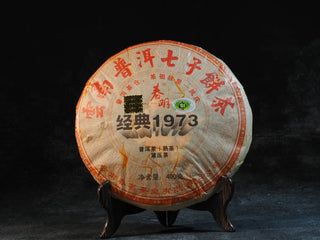
Brew a cup of ripe Pu-erh, Fu Brick, or Liu Bao tea, and one thing stands out: its deep, reddish-brown liquor. But what gives these teas their rich color? And does a darker cup mean a better tea?
One important part of the answer is theabrownins, a complex group of brown pigments that develop during tea processing. They are particularly relevant to dark teas, where microbial fermentation and other chemical transformations help shape the final color and character. Understanding theabrownins offers a window into why different teas look the way they do — and what tea color can, and cannot, tell us about quality.
Key Takeaways
- Theabrownin is the large dark polymer that gives ripe Pu-erh, Fu Brick and Liu Bao their red-brown to near-black liquor — a sign of complete fermentation, not spoilage.
- It only forms through microbial post-fermentation. Black tea stops at theaflavins and thearubigins because its chemistry is enzymatic, not microbial.
- A theabrownin content of 6%–8% produces the bright red-brown liquor you want; below 5% usually means the piling phase ended too early.
- Isolated theabrownin is mildly acidic (around pH 5.0–6.3) and holds its colour best in acidic conditions — the popular "alkaline dark tea" claim does not hold up.
- A 2019 Nature Communications study tied theabrownin to lower cholesterol through gut bacteria carrying bile salt hydrolase and the FXR–FGF15 pathway.
- Fermentation does not destroy caffeine. A typical cup of dark tea still carries roughly 30–60 mg.

How microbial fermentation creates theabrownin in dark tea
The dark red-brown shade of dark tea comes from a step-by-step chain of oxidation and bonding. Fresh tea leaves start with natural catechins that first oxidize into orange-red theaflavins, which then link up to form deeper thearubigins. Most teas stop changing at this point. Dark tea, however, undergoes a special microbial fermentation that drives these parts through one final change into theabrownin. This large, durable polymer is remarkably stable in the mildly acidic conditions it actually sits in: isolated theabrownin fractions test between pH 5.0 and 6.3, and they hold their color far better in acidic solution than in neutral or alkaline ones (Food & Machinery, 2023, in Chinese).
This deep shift requires plenty of moisture, steady heat, and active fungi. That living environment is what truly sets dark tea apart from every other tea style. Regular black tea relies entirely on natural enzymes found inside the leaf itself. You can explore why black tea stops at enzymatic oxidation to see how its chemistry differs from true microbial fermentation. Dark tea uses wet-piling, known as wodui, which brings in external enzymes made by beneficial fungi. These enzymes dismantle smaller thearubigins and assemble them into much larger, darker units. To see how these pigments fit into the wider world of tea, you can read our guide to the color of tea for a solid foundation.
In a nutshell: Dark tea gets its deep color through a series of chemical changes during processing. In ripe Pu-erh, Fu Brick, and Liu Bao, microbial fermentation helps transform tea compounds into darker pigments, including theabrownins. These pigments contribute to the tea’s rich red-brown color, but they are only part of the story — the final color also depends on the tea’s raw materials and processing methods.
| Metric / Parameter | Value / Specification | Actionable Meaning |
|---|---|---|
| Optimal liquor color standard | 6%–8% theabrownin | Target this threshold for bright red-brown infusions. |
| Fermentation floor | Below 5% theabrownin | Reject batches below this cutoff due to under-processing. |
| Post-production maturation | 180 days minimum | Hold inventory through this aging window before market sale. |
| International classification | ISO 20715:2023 | Verify import documentation against this standard code. |
| Brewing ratio | 1:20 to 1:25 | Dose leaf mass to hot water volume using this proportion. |
| Daily intake limit | 12 g leaf | Measure maximum dry intake for healthy adults against this cap. |
| Caffeine concentration | 30–60 mg per cup | Track single-serving stimulant loads within this baseline. |
| Target bioactivity pathway | PTP1B enzyme inhibition | Monitor metabolic activity via patent CN101474313B protocols. |
| Extraction solvent | N-Butanol | Use this solvent phase to fractionate bioactive crude extracts. |
Standardizing these living cultures marked major turning points in modern tea history. Tea makers established the Liubao cold piling process in 1958, which helped workers lock in the exact moisture and heat levels needed for steady mold and yeast activity. In 1973, tea masters adapted these piling ideas to Yunnan's large-leaf trees to launch Ripe Puer. Soon after, trials confirmed the Pu'er cold fermentation method in 1975. Thanks to these discoveries, dark tea grew from an unpredictable aged leaf into a reliable, science-backed product that yields steady pigment levels every run.
Which Chinese teas actually contain theabrownin molecules
Processing methods decide whether a tea contains these dark pigments. Green tea and white tea are heated or dried quickly to stop natural plant enzymes in their tracks, which leaves them with almost zero theabrownin. Standard black tea holds only tiny trace amounts because its chemical reactions stop at thearubigins. The true homes of this heavy molecule are authentic Chinese dark teas: Ripe Pu-erh, Fu Brick, and Liu Bao tea.
All three styles pass through heavy post-fermentation steps that feed helpful colonies of microbes. In Ripe Pu-erh, damp leaves sit in deep piles for weeks during the wodui process, speeding up chemical bonding across all polyphenols. The resulting dark brew carries large amounts of theabrownin, which takes the place of bitter catechins to give the cup a thick, velvety texture. Fu Brick tea follows a separate path called fa hua, or flowering, where workers press leaves into tight bricks inside climate-controlled rooms to grow Eurotium cristatum. This golden fungus releases external enzymes that turn lighter pigments into rich theabrownin. Liu Bao tea uses double-steaming and stores leaves in loose bamboo baskets, which lets dark polymers build up at a slow, measured pace over time.
If you want to taste what fully developed theabrownin actually does in the cup, these three styles are worth brewing side by side: our ripe Pu-erh collection, our Fu Brick tea collection, and our aged Liu Bao collection.
 |
Benchmark Pick · Xi'an Dry-Stored 2017 Lincang Gongting Ripe Pu-erh | 400g Dry-Stored Cake Fine gongting-grade leaf from Lincang, dry-stored in Xi'an rather than a damp cellar. Brews exactly the bright red-brown liquor described above — thick, sweet, and clean on the finish. |
- ISO 20715:2023, Tea — Classification of tea types officially defines the international standard that classifies post-fermented leaves into the dark tea category.
- A theabrownin content below 5% serves as a clear indicator of insufficient fermentation, while a range of 6%–8% produces the expected bright red-brown liquor.
- Isolated theabrownin fractions are mildly acidic, testing between pH 5.0 and 6.3, and stay most stable in acidic conditions rather than alkaline ones.
- Processing records establish that cold piling began in 1958, followed by the introduction of shou production techniques in 1973 and successful trials of cold fermentation in 1975.
- Finished products require a minimum aging duration of 180 days before they are cleared for commercial sale.
- Daily consumption targets should align with the recommended 12g limit for healthy adults to keep stimulant exposure within predictable bounds.
- Each prepared cup provides between 30–60mg of caffeine when leaves are brewed using a standard tea-to-water ratio of 1:20 to 1:25.
- Laboratory validation of therapeutic potential is documented in patent CN101474313B for targeting protein tyrosine phosphatase 1B in metabolic disorders.
Moisture and microbes over time tie all of these teas together. If a tea skips this post-fermentation phase, its chemistry will never build these heavy structures. To see how these methods group together, you can read what fermented tea is to explore how microbial work defines the entire dark tea family.
What the depth of tea liquor actually means
Looking at the brewed liquid gives you an instant reading of what happened inside the leaf. The amount of theabrownin determines whether the cup turns out bright red, dark chestnut, or murky orange. When the theabrownin level reaches 6%–8%, the brew shows off the bright red-brown color found in top-tier Ripe Pu-erh and mature Liu Bao. Even with such a deep shade, light easily passes through the liquid instead of getting trapped inside.
When fermentation falls short, theabrownin drops below 5%. Teas with these lower numbers pour out a pale orange-red that misses the rich body you expect from a fully fermented leaf. This weak color usually means workers ended the piling phase too early, or the piles lacked the heat and dampness needed to fuse thearubigins together.
The tea continues to evolve long after it leaves factory shelves. Ripe Pu-erh completes most of its fermentation in the factory, so it brews a rich red-brown right away. Liu Bao tea, by contrast, relies on quiet warehouse rest to polish its color and clarity. Liu Bao's geographic indication rules require a rest window of at least 180 days before sale, giving the young polymers time to settle down. As the leaves rest under clean storage, floating particles fall out of suspension while the theabrownin bonds tighten, shifting the cup from a hazy dark red into a bright, glowing amber-black.
| Theabrownin Proportion | Visual Appearance | Fermentation Status |
|---|---|---|
| Below 5% | Red-orange, relatively light, highly transparent | Insufficient fermentation or early-stage transformation |
| 6%–8% | Red-brown, bright, deep but highly translucent | Optimal fermentation, mature and stable chemical profile |
| Above 8% | Near-black, deep mahogany, thick viscosity | Heavy fermentation or extended aging in humid conditions |
That slow shift from hazy to glowing is easiest to taste in Liu Bao, because warehouse rest is where this tea earns its clarity.
 |
Classic Pick · Betel Nut Aroma 2014 Aged Liu Bao Dark Tea | Betel Nut Aroma, Cooling Finish Basket-aged Wuzhou Liu Bao carrying the betel-nut sweetness and cooling finish the style is known for. A clean illustration of how warehouse rest turns a hazy dark red into bright amber-black. |
Health benefits and safety of drinking theabrownin
Theabrownin is a safe, water-soluble molecule made when helpful molds break down original tea polyphenols. Because living microbes build it naturally without synthetic chemicals, it carries no toxic side effects. Food authorities around the world treat these natural tea compounds as safe for daily drinking. Its large size stops it from slipping straight into your bloodstream; instead, it journeys down to your lower gut, where it gets to work directly with your digestive system.
Recent science reports, including a 2019 study published in Nature Communications, shed light on how this molecule supports human wellness. Its main job happens inside the gut microbiome. In that study, theabrownin reduced the population of gut bacteria that carry bile salt hydrolase (BSH), the enzyme gut microbes use to split bile acids apart. With less BSH activity, conjugated bile acids build up in the ileum, which suppresses the intestinal FXR–FGF15 signalling pathway. That releases the brake on bile acid production in the liver and increases the amount excreted in feces. Because bile acids are made from cholesterol, the liver draws more cholesterol out of circulation to keep up, and serum and liver cholesterol levels fall.
The same study reported lower triglycerides and reduced fat synthesis in the liver of mice, and the cholesterol-lowering effect also showed up in a small four-week human trial: 13 healthy men drinking instant Pu-erh tea twice a day posted significant drops in total cholesterol and triglycerides, though their body weight did not change over the four weeks. These health benefits stem straight from living microbial fermentation, which means unfermented teas cannot produce these specific digestive triggers.
Curious what properly fermented shou actually tastes like?
Every ripe Pu-erh we stock is dry-stored in Xi'an and tasted before it ships — no damp-cellar notes, no muddy liquor.
Browse Our Ripe Pu-erh Collection →Debunking dark tea myths about caffeine and aging
A common myth among tea fans is that fermentation destroys caffeine, leaving dark teas stimulant-free. In real chemistry, caffeine is a tough alkaloid that easily survives the high temperatures and active mold inside the damp piles. Fermentation breaks down catechins and bitter amino acids, but the caffeine stays almost untouched. A regular cup of dark tea holds 30–60mg of caffeine, giving you a clean boost of alertness. Ripe Pu-erh feels calming because its bitter, jittery catechins have transformed into gentle polymers, not because the stimulant vanished.
Another popular belief is that older tea is always superior. While clean aging rounds out sharp flavors and clears up the cup, the main health perks—especially the fat-balancing power of theabrownin—are already locked in during factory fermentation. A well-made, fresh Ripe Pu-erh already holds huge reserves of this helpful polymer. Storing it for thirty years will build earthy aromas of camphor or cedar, but extra years will not multiply its digestive benefits.
Shoppers also mix up tea types by blending plant origins with processing styles. To clear up global confusion, standard ISO 20715:2023, Tea — Classification of tea types formally cataloged Ripe Puer as Dark Tea. This standard places Ripe Pu-erh in the same family as Fu Brick and Liu Bao, settling old arguments about whether it needs its own category. The true marker is living post-fermentation, not just the age or source of the leaf.
How laboratories isolate and quantify theabrownin content
Testing the exact amount of this polymer in a lab requires separating tea pigments by their chemical pull. Brewed tea is a busy mixture of catechins, theaflavins, thearubigins, and theabrownin, so researchers isolate the dark brown compound through step-by-step liquid washes. Lab techs start by mixing the brewed tea with ethyl acetate. This solvent pulls out polar theaflavins and loose catechins, leaving the heavier polymers resting behind in the water.
Next, the remaining water mix is washed with n-butanol. This second solvent draws out thearubigins into its own layer. What stays behind in the water is almost pure theabrownin, which dissolves easily in water but refuses to blend into ethyl acetate or n-butanol. Once isolated, the liquid goes into a spectrophotometer, which shines specific light beams through the vial to gauge light absorption. The measured darkness matches the exact amount of polymer held in the original tea leaves.
Pulling this pure compound out on an industrial scale is expensive and difficult. Because the polymer is heavy and uneven in shape, purifying it into a shelf-stable powder without ruining its health properties takes serious effort. The equipment and chemical costs make large-scale manufacturing impractical for ordinary items. For most people, the simplest and most affordable way to enjoy this molecule is to brew a fresh pot of Ripe Pu-erh, Fu Brick, or Liu Bao tea.
Ready to taste the difference fermentation makes?
Start with our basket-aged Liu Bao — clean Wuzhou leaf rested the way the geographic indication rules require.
Explore Aged Liu Bao Tea →How to brew dark tea for optimal color
Releasing these large, packed molecules requires plenty of heat. Theabrownin stays tucked tight inside compressed cakes or bricks, and it will not dissolve well in lukewarm water. Getting that deep, glowing red-brown cup calls for steady, high heat. You should always use water heated to 95–100℃; cooler water leaves behind a pale, cloudy drink that tastes flat.
These leaves undergo heavy processing and rest in open warehouses, so a quick rinse is essential. Pour boiling water over the dry leaves and pour it off within five seconds. This quick step cleans off loose dust and storage smells, while the heat shock forces the tightly pressed leaves to swell and share their inner chemistry. For tips on prying apart dense tea bricks, you can read how to brew Fu Brick tea for helpful handling techniques.
 |
Golden Flower Pick · Award Winner On Taoism Jingyang Golden Flower Fu Brick | 350g Cake Pressed in Jingyang and flowered with Eurotium cristatum — the same golden fungus whose enzymes build this tea's theabrownin. Comes apart in layers under a tea pick, so rinsing and dosing stay easy. |
Keeping balanced ratios prevents the tea from turning into bitter, ink-dark broth. Aim for a tea-to-water ratio of 1:20 to 1:25. For example, using 6 grams of leaf inside a 150ml gaiwan yields a rich body that tastes smooth rather than harsh. If you drink tea for daily wellness, stick to the recommended daily intake of around 12g of dry leaf for healthy adults, which easily divides into two satisfying sessions.
Steep time gives you final control over the look of your cup. Let the first steep run for 10–15 seconds. As the leaves loosen up in the pot, add 5–10 seconds to each new round to keep that deep red-brown color steady.
| Step Name | Suggested Parameters | Operational Purpose |
|---|---|---|
| Rinsing (Wash) | 100℃ water, 5 seconds, discard | Removes storage dust, awakens compressed leaves, clears stale aromas |
| First Infusion | 100℃ water, 10–15 seconds | Extracts initial surface theabrownin, establishes baseline red-brown color |
| Middle Infusions | 100℃ water, add 5–10s per steep | Drives heat into the core of the leaf, maintaining thick viscosity and dark color |
| Late Infusions | 100℃ water, 45–60 seconds | Extracts residual sweet compounds after primary pigments have been depleted |
Every year, thousands of tea lovers visit our tea house to enjoy a peaceful cup of authentic Chinese tea. Now, you can bring that same experience home from Orientaleaf.com.
Brew Pro, Buy Smart
≡ Quick Navigation +/−
↑ click header to collapse
1. How microbial fermentation creates th… 2. Which Chinese teas actually contain t… 3. What the depth of tea liquor actually… 4. Health benefits and safety of drinkin… 5. Debunking dark tea myths about caffei… 6. How laboratories isolate and quantify… 7. How to brew dark tea for optimal color