If you've ever stood in front of a wall of ripe pu'er (shou cha) with no idea which one was actually good, you're not alone. Even inside China, the industry has never fully agreed on what "good ripe pu'er" means. That disagreement came to a head on September 21, 2026, at the first-ever Ripe Pu'er Congress in Guangzhou — and, in my view, that's exactly what the event turned out to be: an attempt by the industry's biggest names to redefine, on their own terms, what counts as a good ripe pu'er.
Here's my take on what that means for you as a buyer, and the four things I'd actually check before spending money on a ripe pu'er — including our own.
The Congress: One Shared Goal, Four Different Definitions

Dayi (TAETEA), Langhe, Chenshenghao, Shuangchen and Buxiashan jointly hosted the event, with major houses like Xiaguan, Lancang Ancient Tea, Suiyue Zhiwei and Shanqing Huaran taking part. Everyone agreed on the surface goal: grow ripe pu'er into a true everyday tea, not just an occasional pour, and turn first-time drinkers into repeat buyers.
But underneath that agreement, each house pushed a different idea of what quality actually means:
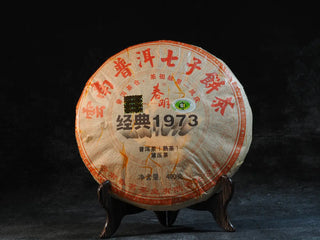
- Dayi leaned on more than fifty years of fermentation research — from artificial pile fermentation in 1973, to the iconic 7572 recipe in 1975, to a microbial fermentation method introduced in 2016. Their argument: quality means a process precise enough that the tea tastes like itself, batch after batch.
- Shuangchen emphasized cleanliness, mouthfeel, and professional, controlled storage.
- Several brands argued that origin and terroir — the specific mountain the leaf came from — should be central to how ripe pu'er gets judged.
- Lancang Ancient Tea leaned on its established classics and house style.
- Shanqing Huaran is experimenting with entirely new fermentation techniques.
None of these are just technical preferences. Whichever framework wins in the market will decide how ripe pu'er gets graded on shelves, what a shop recommends first, and what a customer is willing to pay a premium for. That's a lot of leverage to hand to any single brand's definition.
My Standard: Four Things, Not One
I've spent years pouring this tea for people trying it for the first time, and I don't think any single answer from the congress is complete on its own. A genuinely good ripe pu'er has to meet all four of these, not just the one its brand happens to be best at:
- Traceable origin. You should be able to know where the leaf actually came from, not a vague regional label.
- Clean fermentation. The pile fermentation process should be controlled and hygienic, not left to chance.
- Clean storage. How a tea is stored after production matters as much as how it was made.
- Stable quality with a recognizable style. It should taste consistent across batches, and have a character you could identify blind.
That fourth point is the one people underrate. Consistency alone just gives you a predictable beverage. Consistency plus a distinct character is what makes it a tea worth seeking out, rather than a commodity.
If you want to train your palate on what the failures taste like, our guides to why pu'er smells fishy and wet vs. dry storage aging show exactly what unclean fermentation and poor storage do to a tea.
Want to taste what all four criteria feel like in one cup?
Our Xi'an dry-stored shou collection is built around exactly these four checks — named origins, clean fermentation, and the same low-humidity storage since the day each tea was pressed.
Browse the Xi'an Dry-Stored Shou Collection →How This Plays Out in a Real Tea: Xi'an Dry-Stored Shou Pu-erh Discovery Box
To make this concrete rather than abstract, here's how we apply these four criteria to our Xi'an Dry-Stored Shou Pu-erh Discovery Box, one of our own ripe pu'er selections:
- Origin: Six ripe pu-erhs from named origins — Lincang (2017 Gongting, 2013 ancient-tree brick, Ancient Grove 2018), high-mountain Menghai (first-spring buds at around 1,400m), and Mengku Rongshi house material — with every vintage stated, from 2011 to 2022.
- Fermentation: The box deliberately spans styles, from standard wet-pile to Mengku Rongshi's off-ground fermentation, a light-to-medium "zero pile odor" approach — so you can taste what the fermentation method itself changes.
- Storage: All six teas have rested in the same naturally ventilated Xi'an facility — 40–55% relative humidity year-round, no artificial climate control — since the year each left the factory. Storage is held constant, so what differs in the cup is the leaf, not the warehouse.
- Consistency: Each tea is also sold individually in full size, so the profile you identify in the 30g sample is the one you re-buy — and the included tasting card lets you score body, sweetness, and aroma the same way across all six.
That's not a marketing claim, it's a checklist you can ask any brand to answer, including us. If a brand can't give you specifics on all four, that's worth noticing.
 |
Editor's Pick · 6 Teas, One Storage Xi'an Dry-Stored Shou Pu-erh Discovery Box | 6 Teas, 250g Six ripe pu-erhs from the same Xi'an dry-storage facility, spanning vintage, leaf grade, and fermentation style — with a tasting card to score each one side by side. Free worldwide shipping. |
Concepts Aren't Standards Yet

The congress also launched work on a Ripe Pu'er Value Handbook — an early step toward a shared industry language. But a real standard has to be testable, comparable, and repeatable, and it has to make sense to an everyday drinker, not just a specialist. Right now, it's a starting point, not a finished tool.
Whatever story a ripe pu'er tells — mountain origin, microbial science, storage pedigree, new fermentation methods — it should be able to answer four plain questions:
- Is the liquor clean?
- Is the style clearly defined?
- Is the quality consistent?
- Would you buy it again?
Rather judge six dry-stored shou side by side?
One storage, six teas spanning vintage, grade, and fermentation style — 250g with a tasting card, free worldwide shipping. The fastest way to find your own standard.
See the Xi'an Discovery Box →The Bottom Line

China's first Ripe Pu'er Congress didn't settle what makes a good ripe pu'er. What it did was put the question in public, with the industry's biggest names arguing their case in the open — and, in my view, quietly competing to own the definition. That's healthy for an industry that's spent years selling ripe pu'er more on price than on quality.
Until an official standard exists, use the four criteria above as your filter: traceable origin, clean fermentation, clean storage, and consistent, recognizable quality. Ask any brand, including us, to answer all four specifically. If they can, you're buying with real information. If they can't, you're buying a story.
Want to see exactly how the Xi'an Dry-Stored Shou Pu-erh Discovery Box measures up? Check the full breakdown here or reach out with questions — I'll answer them directly, not with a marketing script.
Every year, thousands of tea lovers visit our tea house to enjoy a peaceful cup of authentic white tea. Now, you can bring that same experience home from Orientaleaf.com.